He called the calm denial. The chain assumes the spending never stops.
Michael Burry posted Tuesday that stocks are in the denial stage he dates to 2000 and 2008, and that the stage lasts six to nine months. Under it sits an Ares matrix of about $573 billion. Tuesday's tape closed at a record.
NEW YORK — October 8, 2026
Thursday morning’s document is a post, not a crash. On Tuesday, October 6, Michael Burry wrote on X, as Cassandra Unchained, that the stock market is in denial. Phil Haunhorst at BeInCrypto, in a story time-stamped 8:07 UTC that same day, prints the post. Namrata Sen at Benzinga, in a story published 4:39 a.m. Eastern on Wednesday, prints it again. The sentence is his.
“The stock market is quite obviously in its first stage of grief, denial. Per 2000 and 2008, this stage lasts 6-9 months.”
That is not a date for a bottom. It is a claim about how long the part can last in which the tape still looks fine. The same day’s close is the part that looks fine.
Denial, on his clock, is a stage that can run half a year. The index set a record while he was saying so.
The calm is the exhibit
A reader asked whether the six-to-nine-month line made him bullish. Benzinga carries the reply as he posted it. “We are somewhere in there, hard to say where. But Private Equity and Private Credit are getting torn apart under the surface of the calm, and those insurance companies I’ve been on about are holding too many bad assets.” Benzinga then summarizes the rest: the stress reaches data-center financing, particularly where projects are delayed, and companies are standing up small language models on whatever is cheapest, including Chinese open-weight models. This desk is not going to finish a sentence the story left mid-clause.
Read the two posts in the order he wrote them. The first names a stage and gives it a length taken from 2000 and from 2008. The reply names what he thinks is already failing under a market that has not failed. Calm, in that reply, is not a compliment. It is the surface.
He is narrow about the history. “Per 2000 and 2008” means the denial stage, in those two episodes, ran six to nine months. It does not mean the next six months will match either crash in every particular, and it is not a price. BeInCrypto’s accompanying history — a slow start, then much larger losses — is the outlet’s gloss. The document this morning is the length of the stage.
The chain was already drawn
The dollar figure under Tuesday’s post is not from Tuesday. Deepti Sri at Stocktwits, in a story published at 12:57 a.m. Eastern on September 28, reports that Burry had used late Sunday for an unscheduled note after reading Ares Management’s Fall 2026 alternative-credit newsletter. Stocktwits says he called the findings “need to know now” information and “can’t-wait info,” and called the report “mainstream Wall Street coming around to my view.” The note, on that account, ends without a model. “Bubbles are indeed painfully obvious. Painfully.”
What Ares mapped, as Stocktwits describes it, is about $573 billion across 26 disclosed financings in the prior twelve months. The list is corporate bonds, data-center construction loans, leases, borrowing backed by GPUs, and financial guarantees. The names are Meta, Oracle, Microsoft, Amazon, Google, Nvidia, OpenAI, and Anthropic. They do not sit on one side of the table. Stocktwits says the same firms appear as borrowers, customers, chip suppliers, tenants, or guarantors, so a change in one company’s spending is a change in someone else’s customer, collateral, or backstop.
The line Burry wanted in front of people, as Stocktwits quotes Ares, is that “every transaction, obligation, backstop, guarantee and deal” in the web assumes sustained AI spending. If revenue disappoints and a few boards move the money, the pressure runs through the connected deals, and the guarantees are triggered “precisely when the guarantors are at their weakest.” Ares compared that structure to the vendor financing that amplified the telecom downturn of 2000. Tobias Burns at CNBC, later the same Monday, quotes Ares on how long the disappointment has to last. “It would take only a season in which AI revenue disappoints the capital expenditure underwriting it.” A handful of boards, already disposed to fund whatever they believe most, would only have to conclude that the highest-conviction bet had shifted. “The legal documents contemplate that decision.”
CNBC’s Monday story is the other half of that weekend. Burry wrote that he was “moving timelines up,” and that he wanted puts rather than straight shorts because volatility was cheap. He thought “the bubble in AI may burst sooner than later.” Tuesday’s denial post is the clock hung on that wall. Six to nine months is a long time to be early. It is a short time if the contracts, as Ares describes them, are written to speed up on a bad season rather than to wait out a cycle.
Two insurer figures in the Stocktwits account should not be added. Burry, the story says, put the combined float of U.S. and Bermuda insurers a little above $10 trillion. Ares, on a different measure, cited $9 trillion in invested assets at U.S. insurers. The use of either number is who is left to hold the paper. The same account says Ares pointed to Meta and BlackRock’s $14 billion El Paso site and to fire coverage capped at $450 million, about 3 percent of the project, and set that thin property cover against a willingness to own the investment-grade debt. That is a mismatch of appetite. It is not, by itself, a fire.
Revenue is the bull case. It is also the assumption.
The tape did not flinch. John Power at Al Jazeera, in a story published Wednesday, has the S&P 500 up 0.58 percent on Tuesday, a record, above the prior peak from mid-August. The Nasdaq Composite finished up 0.45 percent, also at a record. On the year, Al Jazeera has the S&P 500 up 14 percent and the Nasdaq up 18.78 percent. John Towfighi at CNN, in the Tuesday-session story carried by KIFI, puts the S&P close at 7,819, the first finish above 7,800, and has the Nasdaq on back-to-back record closes Monday and Tuesday.
The objection with a balance sheet behind it is that these are not brochure companies. Microsoft, Amazon, Alphabet, Meta, and Nvidia sell cloud, ads, and chips to customers who already pay. A 1999 ticker could be a lease and a story. That difference is real, and it is the reason a record can be rational rather than a trance. It is also incomplete. OpenAI and Anthropic are on the same Ares list, and they are not those public income statements. This desk is not going to invent a private-lab revenue figure to make the list symmetrical.
Burry has already granted the public half of the objection. In the free portion of a September 24 note, Capital Cycle IQ & the Forensic Files of the Big 5 Hyperscalers, he writes that “the most profitable companies in the world, except Apple, are betting everything on this as their free cash flow turns negative and the borrowing pace increases.” Profit is not the fact he forgot. It is the premise. A profitable company can still sign a web of guarantees that works only if the next season of AI revenue does not disappoint. Ares’s season is the test. The existence of revenue is not a pass.
The people on the other side of the trade are not pretending the market is broad. Keith Lerner of Truist told Al Jazeera the rally should be seen as a “technology and AI surge,” and then said it in his own sentence. “Every bull market has a dominant theme, and technology and AI remain this market’s dominant theme.” Lochlan Halloway of Morningstar Australia told the same outlet that investors “are betting that the money pouring into data centres will earn a good return,” and that the bet has so far outweighed higher rates, more expensive oil, and a 10-year yield above 5 percent. The next sentence is the limit on the bet. “But the range of outcomes is wide, and the market is concentrated in a handful of companies, so the outlook for US shares, and by extension global shares, relies on the AI story continuing to deliver.” Ulrike Hoffmann-Burchardi of UBS, in the CNN story, held both halves. “We retain strong conviction in the AI growth story, and believe AI-related investment remains a powerful tailwind for the broader equity market.” The next sentence is the caveat. “But the increasing concentration of market gains reinforces the importance of managing risk through a broadly diversified equity portfolio.” CNN puts Nvidia at almost $6 trillion and at more than 8 percent of the S&P 500. An equal-weight version of the index, the same story says, is down almost 5 percent from its own mid-August record. Craig Johnson of Piper Sandler wrote the short version. “A narrow set of leaders is doing more work than the underlying market.”
That is the denial phase, if you take Burry’s word, described by people who do not accept the word. A record carried by the firms inside the financing web is not proof the web is unstressed. It is proof the equity market has not been asked to price the stress. Six to nine months, on the comparison he actually made, is how long he thinks that can last. One disappointing season, on the Ares language he has been circulating since late September, is how the documents say it stops.
What Thursday morning does not contain
No new holdings filing. The put strikes in CNBC’s September 28 story — Micron around a $500 June strike, Nebius in the double digits for June, semiconductor-ETF puts in the low $400s for September 2027, an enlarged Palantir put position in the low $100s — are that story’s account of the book. They are not a position this desk has re-read off a fresh 13F. Benzinga on Wednesday also said he had argued, the same day as the denial post, that the spending only makes sense if the companies expect an oligopoly too big to fail. Benzinga says that item was partly produced with AI tools and then edited. This desk is not hanging a second quotation on a sentence it has not read in his own note.
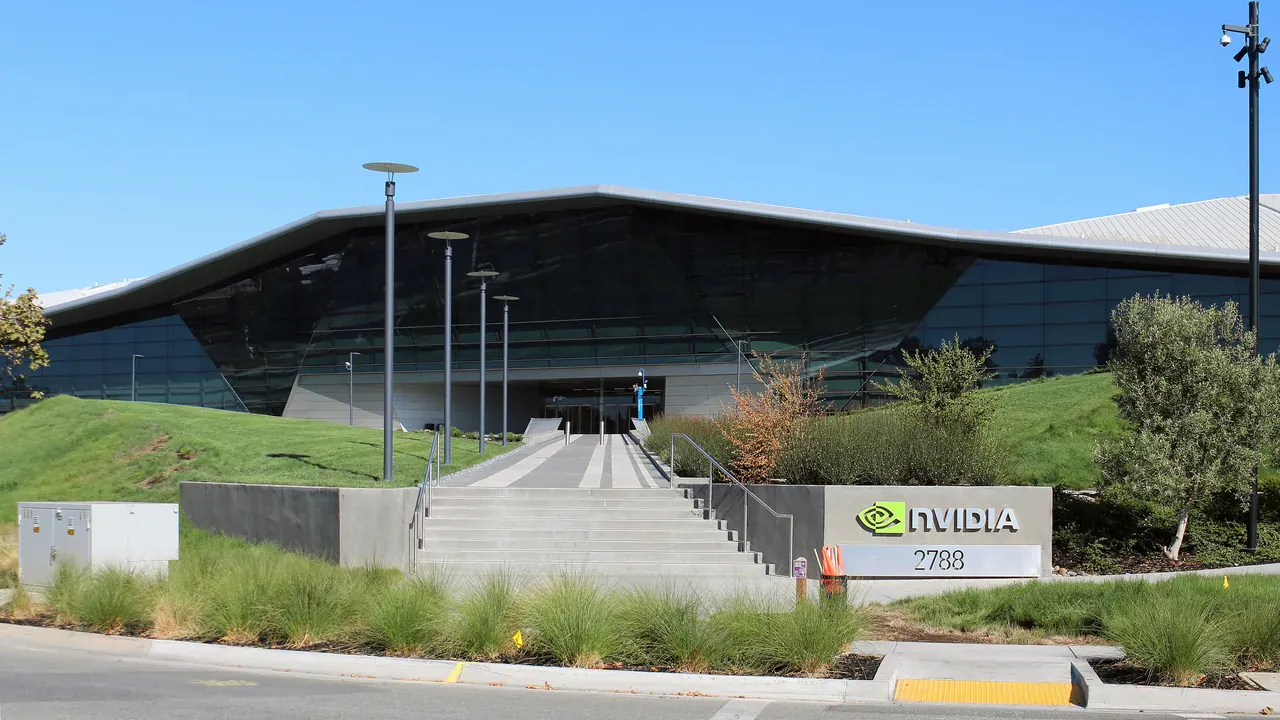
No portrait of Burry that this desk can clear. The photograph is Nvidia’s headquarters in Santa Clara on August 4, 2018, made by Coolcaesar and released under CC BY-SA 4.0. The building is not the man. It is the chip supplier whose name is already inside the matrix. The frame is eight years old. The denial post is Tuesday’s, and the record next to it is a closing price, which is a fact, and not an answer to a guarantee.