Park said the frontier plan fell out of the sky. Bae said the model they have cannot answer Mythos.
At Tuesday’s National Assembly audit, People Power Party lawmaker Park Jung-ha said Seoul’s 4.7 trillion won frontier-AI plan has no visible decision file. Science minister Bae Kyung-hoon said the sovereign foundation model cannot meet a cybersecurity threat after the Mythos shock. The budget has not been voted.
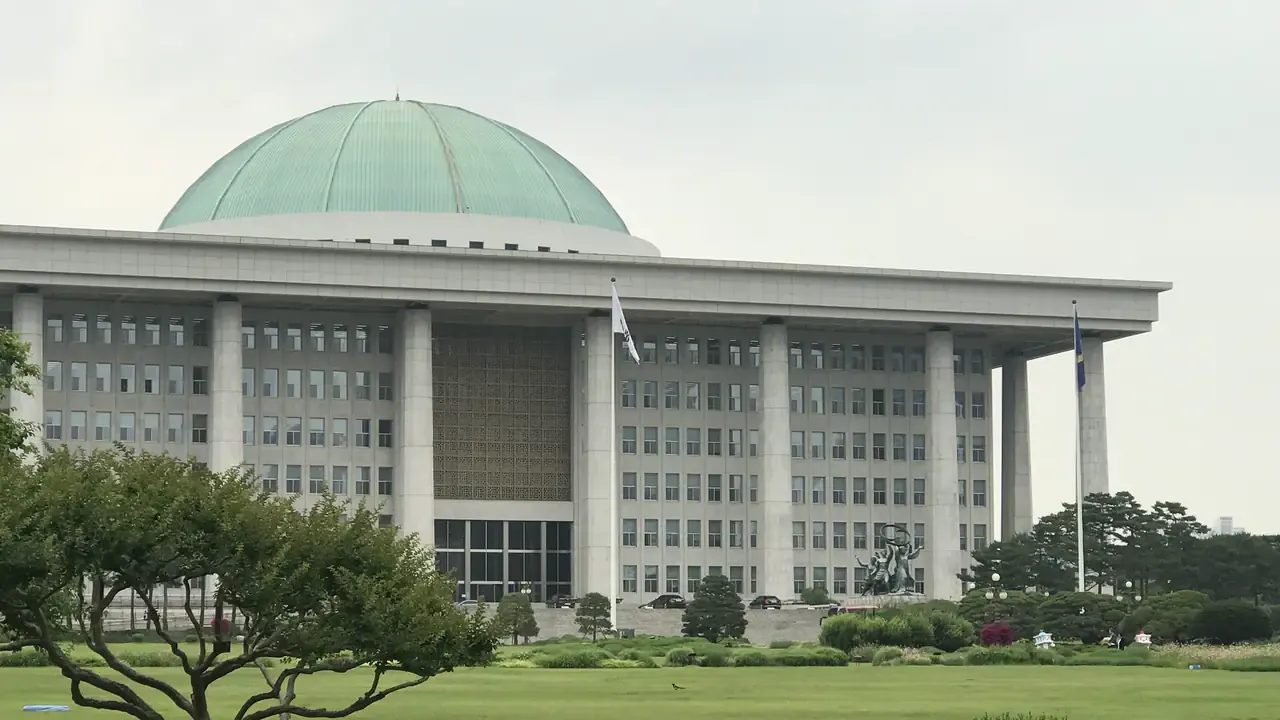
SEOUL — October 6, 2026
Tuesday’s new document is a hearing, not a weight. South Korea’s National Assembly Science, ICT, Broadcasting and Communications Committee audited the Ministry of Science and ICT on the morning of October 6. The won figure was already public. What the room added is a lawmaker saying nobody can see where the frontier plan was decided, and a minister answering with a cyber model his country does not control.
A budget line is not a training run. The man who says the model they already have cannot answer Mythos did not put the decision memo on the table.
There is no way to confirm where it was decided
Seo Ji-hye at Seoul Economic Daily, in a story time-stamped 1:31 p.m., has the exchange. Rep. Park Jung-ha of the People Power Party said the sovereign foundation-model program has produced too little for the promotion it received, and asked whether the government had offered nothing more than a rosy blueprint. He asked whether the frontier project planned for next year overlaps the program still underway, and whether that overlap is a change of direction while the first race is unfinished.
Then the process, which is the story. Government funding alone, Park said, comes to about 4.7 trillion won. Seoul Economic Daily converts that as $3.3 billion. Because the government would hold a 30 percent stake, he said, the whole project would reach roughly 16 trillion won, and the path to the plan has not been disclosed well enough to audit. “There is no way to confirm where and how this was decided.” Then the sentence that names the objection. “It looks like it fell out of the sky.”
A stake is an ownership claim Park put on the record. It is not a number the ministry, in the stories filed so far, has confirmed as 30 percent. Sixteen trillion is his multiplication, reported by one paper. It is not a line in a passed budget. Jie Ye-eun at the Korea Herald, filing Monday on the Friday briefing that put 4.7 trillion won in public, converts the same sum as $3.49 billion and writes that the 2027 budget proposal earmarks it as equity investment, with private capital expected on top, and that the proposal remains subject to National Assembly approval. Nam Hyun-woo at the Korea Times, on that same Friday press conference, converts it as $3.48 billion. Reuters from Seoul on Tuesday converts it as $3.5 billion and says the programme is planned from March 2027. Four dollar signs, one won figure, no model. The Assembly has been asked to approve the money. It has not, on any of these accounts, voted it.
The minister’s answer is Mythos, not a memo
Bae Kyung-hoon, deputy prime minister and science minister, did not produce the file Park asked for. He produced a reason the first project should continue and a reason it is not enough. Seoul Economic Daily quotes him on the program he says is not being dropped. “The sovereign AI foundation model was developed to spread AI into existing industries and the public sector and to improve its usability, and it has been pursued with the goal of developing a world-class model.” The stage, in the same account: “We have completed the second round of evaluation and have entered the third stage.”
The reason he gave for a second project is a calendar in another capital. “With the U.S. government announcing superintelligence, we are drawing up plans for a frontier model that goes several times beyond the level we had originally targeted.” Bae did not, in Seo’s copy, name the page. What Washington put in a name on Sunday is already a file here: a Super Intelligence Force under the spy chief, sitting on a voluntary accord. An announcement in Washington is not a specification for a Korean training run. “Several times beyond” is not a benchmark a reader can score. Competition, he told the committee, has moved faster than expected, so a project at a higher level than the existing program is necessary.
Then the sentence he offered against the sky. “When we assessed whether we could secure AI capable of responding to cybersecurity threats after the Mythos shock, we concluded that the current level of the sovereign AI foundation model would make that difficult to achieve.” And the denial, which answers Park’s image without answering Park’s question. “Frontier AI is not a project that suddenly fell out of the sky.” He added, in the same paper, that the ministry needs frontier AI for humanity’s unsolved problems and for cybersecurity challenges existing AI cannot handle, while the foundation-model program stays on its original course. Two projects, on his account. One memo, still not in the room.
Lee Eunseo at Asia Business Daily, publishing at 5:24 p.m., prints a different English sentence for what reads as the same answer. “After the Mythos shock, we questioned whether we could secure AI capable of responding to cybersecurity threats, and concluded that the current level of our independent foundation model is unlikely to reach the standards required for industrial and public sector AI applications.” One rendering is a cyber response the current model cannot make. The other is an industrial and public-sector standard the current model is unlikely to meet. Both are translations. This desk will not weld them into one quotation. What they share is the move. The project already running is, on the minister’s account, not the instrument for the threat he is now citing. Asia Business Daily also says the ministry told the audit it will accelerate frontier AI and physical AI while keeping the independent foundation-model project. Physical AI is a phrase in that story. It is not a design.
Mythos is not a rumor that started on Tuesday. It is the name Korean officials have used since the spring for Anthropic’s restricted cyber model. The export-control file already has the fact that matters to a foreign ministry: Washington has kept the top Anthropic weights off foreign desks, and a Mythos-class system is not a courtesy copy. A minister who says his own foundation model cannot answer that class of system is describing a gap. He is not describing a weight Seoul has trained. The gap is the argument for the money. The money is still a proposal in front of the committee that just asked where the proposal came from.
Friday spent the nouns. Tuesday spent the cross-examination.
The plan Park called a skyfall was briefed on Friday, which is why Tuesday is not the invention of 4.7 trillion won. The Korea Herald has Second Vice Minister Ryu Je-myung telling reporters the ministry will “evolve the technology development goal toward frontier models, while separating industrial deployment into a new track.” He rejected the reading that the independent foundation-model project, which the Herald says is known in Korean as Dokpamo, was being abandoned. “The goal of securing our own foundation model technology has not changed, and it will not be discontinued.” “It will continue.” The teams still in it, on that account, are led by LG AI Research, SK Telecom, and Upstage. “We will select two. That is certain.”
The scale he called insufficient is the one the old plan actually named. “Investment on the scale of 1,000 GPUs is not enough to catch up with frontier-class models.” “The scale has to be completely different.” He said a head-on race with the largest American labs would be unrealistic, and that Korea could aim at a model competitive with leading Chinese open models if the public and private money arrives. Participation, he said, “should be open,” including startups. The Herald’s clock: the third stage runs through January, results around mid-February, the new competition opens after the Assembly approves the 2027 budget, expected in December, and the program could start as early as March. Reuters’ Tuesday account is a competitive tender after that December vote, a winner possibly as early as February, and a start in March 2027. A February name and a March start can share a year. Neither is an appropriation. The Herald also says the ministry is preparing to allocate about 29,000 graphics processors the government has bought or is bringing online, with a distribution plan expected by year-end. A pool of chips is not the 10,000-chip line inside the frontier equity. They are different sentences.
The Korea Times has the shopping list the ministry expects inside the 4.7 trillion, and “expects” is the word. Ryu’s Friday briefing, on Nam’s account, includes 3.9 trillion won to provide 10,000 Nvidia Vera Rubin processors and 800 billion won to buy training data. Companies would have to match the government’s equity with private funding. The structure, the anchor firms, and how startups enter are not finalized. One option he named is a special-purpose company, so that returns can be shared with the public. The ministry plans to show an outline of who may apply later this month. Ryu’s question, in the same story, is the one a decision memo would have answered before a lawmaker had to ask it in an audit. “The question was whether we should target a mid-tier model or one capable of competing with the world’s leading models.” The companies already in the foundation-model project, he said, told the ministry that competing at the frontier would require an approach like this one. A conversation with the firms that would receive the equity is not the disclosure Park said was missing. It is a reason the disclosure matters.
He also said the old contest “created a stigma for companies that were eliminated and stirred public controversy,” and that the ministry knew the risk and treated intense competition as the price of scarce compute. The Times says three teams are in the third stage and that two finalists will be selected by the end of this year, and that those finalists could join the frontier project or stay on industry-specific models, with the original plan of 1,000 processors for each of them through 2027 still available. The Herald’s results clock is mid-February, not the end of 2026, and it says the new competition replaces an automatic extension of compute for the survivors. Read them together and the promise is a choice the papers do not date the same way. It is not a guarantee that the teams which survived the first race own the second.
The Times adds the ministry’s own statement, which is the ambition Bae was still defending on Tuesday. The frontier project, the ministry said, is not a replacement. It is a new initiative aimed at national security needs and other major challenges facing humanity, linked so that talent and technology from the foundation-model contest can feed it. “Challenges facing humanity” is a purpose clause. It is not a threat model, and it is not a weight.
The scorekeepers were in the same room
The other half of the audit is the contest Bae says has entered its third stage. Asia Business Daily has Assemblyman Kim Jangkyum, also of the People Power Party, on the test itself. The paper’s account of what he raised: the lead company on the mathematics dataset reportedly had annual sales of only 150 million won and eight employees, and the lead company on the knowledge dataset had annual sales below 1 billion won and fewer than 20 staff. He noted that 33 of the 49 experts on the first and second specialist user-evaluation panels were the same people. In the expert-evaluation category, which carried the highest weight, LG AI Research placed first and overturned Motif Technologies, which had posted the highest AI benchmark score. Conflict-of-interest controls, on the paper’s rendering of his point, were written pledges. Some development targets were lowered.
Ryu’s answer in that story is procedural. The paper renders his name as Ryu Jemyoung. The sentence is the one that matters. “The evaluation criteria and scoring were thoroughly discussed in advance with all participating companies, ensuring mutual understanding before the assessment took place.” He said the ministry held one-on-one talks on scoring, methods, and how anonymity would work, then made the rules official in a meeting every participating company attended, and gave guidance before and after the assessments. A meeting that adopts the rules is not a showing that the firms writing a national exam were large enough to write it. It is a claim that the contestants were told. Kim’s sales figures and headcounts are the paper’s “reportedly,” attached to a lawmaker’s point. They are not a registry this desk has audited. If they hold, they are about who wrote the test. Ryu’s sentence is about who was briefed.
The Herald’s list of who is still in the third stage names LG AI Research, SK Telecom, and Upstage. It does not name Motif. Asia Business Daily’s account of an earlier expert score names Motif as the benchmark leader the panel did not rank first. A benchmark that an expert panel can outrank is the object the frontier project is being asked to outgrow. Bae’s case for the new money is that the current level cannot meet a cyber threat after Mythos and, in the other translation, cannot meet the standard for industrial and public use. The audit of the test that produced “the current level” was the same morning. A government that wants equity in a frontier model, and that has not finished explaining the score of the model it already sponsored, is asking the Assembly to fund the next race on a leaderboard its own members are disputing.
What Tuesday does not contain
No weight was released. No company was named as the recipient of 10,000 Vera Rubin chips. Reuters says a lead developer would be chosen by tender after the December budget vote, possibly as soon as February. The Herald says the competition could open after that vote and start as early as March. The Times says the application outline is still due later this month. Bae’s “not out of the sky” is a rebuttal to a process complaint. It is not a published decision memo. Park’s 16 trillion won is a stake multiplied out loud, on a percentage the ministry has not, in these stories, confirmed. The superintelligence announcement Bae invoked is not a Korean statute. Mythos is not a model Seoul controls. The morning established something narrower, and it is the part that governs the rest. A legislature asked where the frontier plan was decided. The minister answered with a threat. The file Park asked to see was not the answer.