
Cantwell asked if anyone had seen something else. The penalty is still a dialogue.
Sen. Maria Cantwell, in a Seattle Times interview time-stamped 6:00 a.m. Pacific, unveiled principles she called comprehensive: NIST-led standards, a test and an audit before release, and civil and criminal penalties she has not numbered. Her press page does not carry the document. The Senate is not in session.
WASHINGTON — October 7, 2026
Wednesday morning’s new fact is an interview, not a statute. Anumita Kaur and Destiny Muller at the Seattle Times, in a story time-stamped 6:00 a.m. and updated at 6:01, have Sen. Maria Cantwell unveiling principles for regulating artificial intelligence. She is the ranking Democrat on the Commerce, Science, and Transportation Committee. The Times calls the document comprehensive because she did. The number that would make a lab stop is not in the story.
A principles sheet that names civil and criminal penalties, and does not name one, is not a fail rule. The chamber that would have to write the number is not in session.
She answered a question about teeth with a question
The Times asked whether the principles are aggressive or specific enough. Cantwell’s reply is the sentence to keep. “Have you seen something else?” Then the claim. “These are very comprehensive, in the way that the system could work. But now we have got to get people to dialogue about that.” The next sentence is the method. “We have to hear from people about what that looks like. We’re not trying to be vague. We’re saying that it is part of the process of figuring out what it actually would look like.”
Read the pair in the order she gave it. Comprehensive is her adjective for a system that could work. Dialogue is the verb she put on the morning the adjective was asked to prove itself. A process of figuring out what a rule would look like is a schedule. It is the opposite of a fine already printed.
Her office, the Times reports, says the principles are likely to evolve as the discussions continue. An evolving page is a draft by her own staff’s account. The Times also says the principles are a precursor to more comprehensive legislation she says is imminent. Imminent is her forecast. It is not a bill number.
What the interview was willing to specify
Hold the Times’s account at the size of an interview. This desk has not been shown a principles PDF. The press-release index on Cantwell’s Senate site, loaded Wednesday morning, opens on a September 30 item. Nothing dated October 7 sits on that page. The Commerce committee’s public releases, searched the same morning, do not carry the document either. The experts the Times quotes had not seen it. What follows is what two reporters were told, and what they were told is still the only public text.
Cantwell wants enforceable safety standards written by the National Institute of Standards and Technology, with the Department of Energy, the Department of Defense, researchers, and frontier companies. The Times says she would first build what she calls a national AI ecosystem: frontier companies, universities, independent researchers, and the federal government. NIST would lead that group in setting mandatory safety and security standards for the advanced systems that pose the most risk. The examples the story prints are cyberattacks and the potential loss of human control. The standards would be updated as the technology moves.
Advanced models, on this account, would face government testing, third-party testing, or both, and then a third-party audit before release. Companies that fail to comply could face civil and criminal penalties. Government and independent experts would keep stress-testing the systems after that. Then the clause that governs the rest of the paragraph. “The precise testing and oversight regime has yet to be determined.”
The same story says the key details still open include the penalties for noncompliance and what the third-party auditing entity would be. Developers would have to give testers and auditors access, and would have to report safety incidents promptly. The principles, the Times says, do not define “promptly.”
A mandatory standard with an undetermined test, an unnamed auditor, an unnumbered penalty, and an undefined clock is a list of jobs. It is not yet a gate. The categories are real. Cyber and loss of control are the risks she is willing to put in a newspaper. The instrument that would catch a model before it ships is the part still being discussed.
The rest of the list, still on the Times’s telling, is transparency, public-private partnerships, social harms, global cooperation, protections for children online, and a requirement that companies fund apprenticeships, education, and worker training against displacement. Environmental harms are absent. Asked, she said “they should be.” Should be is a revision she has already conceded. It is not a line in the principles as described.
One proposal should not be stapled to a different phone. The Times says she also wants a “secure channel” with China for a significant AI incident that could threaten either country or international security. The line that was already stood up, and the manual it did not come with, is a different file. Do not reopen it. Wednesday’s channel is a sentence in an interview. It is not an operator, and it is not a penalty.
The bill she can already point to still says voluntary
The Times says the new principles largely replicate the core ideas of the Future of AI Innovation Act she wrote with Sen. Todd Young, Republican of Indiana, in 2024. That bill, the paper says, sought voluntary standards and assessments and a test-bed program at classified national labs, and never reached a vote on the Senate floor.
The text a reader can open this morning is the reintroduction, not the Wednesday principles. On February 26, Cantwell, Young, Sen. John Hickenlooper, and Sen. Marsha Blackburn put the bill back in. The Commerce committee’s release is explicit about the adjective. The bill authorizes the Center for AI Standards and Innovation at NIST “to promote the development of voluntary standards.” Cantwell’s own sentence in that release is the same word. The legislation would “develop voluntary standards for AI, create new assessment tools, and conduct testing.” The numbered summary says the institute will develop “voluntary guidelines and standards” with companies and agencies. Test beds, grand challenges, public datasets, and an allied coalition are in the release. A civil fine is not. A criminal fine is not. A power to block a release is not.
Hold the two mornings apart. February’s page, which this desk can read, says voluntary. Wednesday’s interview, which this desk cannot read as a document, is described as mandatory, with civil and criminal penalties whose size is unresolved. A newspaper’s account of a shift is evidence that she is now urging enforcement. It is not a substitute for the page. Her line to the Times about the older effort is narrower than a conversion. “When we tried to pass some of these ideas in a bill two years ago, they got blocked, and so I’m hoping that this will now get us back to a more participatory framework with our colleagues from both sides of the aisle.” Blocked is a history of a floor. Participatory is a hope about colleagues. Neither sentence is the penalty.
She added that there are Republicans who believe in standards, and that the work is to find the ones who will pursue that avenue. Finding them is a whip count. It is not a markup.
The industry’s ask is not the authority in the interview
The Times says the approach echoes calls already on the record from the labs. It reports that Anthropic chief executive Dario Amodei has called for mandatory third-party evaluations and for federal authority to block a model on the findings, and that OpenAI chief executive Sam Altman has agreed independent evaluators should have access of the kind an employee has. Those are the paper’s characterizations of positions this desk has already filed elsewhere. They are not new quotes from Wednesday, and they should not be laundered into the principles.
What the interview actually describes is a test, an audit, access for the testers, and a penalty whose number is open. It does not describe a federal power to stop a release when the audit fails. Tuesday’s letter from Warren and Blumenthal asked the administration what happens when a model fails. Wednesday’s principles, as told to the Times, still answer with a category of punishment and not with an action. An echo of a block is not a block.
The voluntary page already signed downtown does not need to be retold to stay in the frame. The four rules named no penalty. Cantwell’s opening, in the Times, is that the moment to use is the industry’s own call for oversight and its fear of what could happen, in order to get more people on the same page. A fear that gets people into a dialogue is a political opportunity. A fear that stops a training run is a rule. She has claimed the first. The second is the part she says the process will figure out.
The president’s noun for that fear is already on file. The Times records that he has dismissed warnings about catastrophic risk as a “hoax.” That word was the seating chart days ago. Wednesday does not revise it. A ranking member offering a dialogue, and a president offering a hoax, are two theories of the same empty week. Neither theory is a numbered fine.
Mid-November is a few days, not a regime
The calendar is the enforcement problem, and the Times prints it without a euphemism. The House and Senate will not reconvene until after the midterm election. When they return in mid-November, the chambers will have few remaining days in session together. The paper’s conclusion is that comprehensive AI legislation this year is unlikely.
Cantwell’s answer to that calendar is a split. She thinks the larger bill can move next year. She suggested the remaining weeks could be used for short-term guardrails against the biggest risks. She did not elaborate. The Times says she pointed instead to NIST and the Department of Energy. Then the sentence that pretends the recess is a workshop. “I do think that they can right now come up with the biggest risk scenarios and outline them, and that should be something that we could get done quickly while they’re looking at the larger system. Congress can move fast when it wants to, and it feels like it’s under threat.”
They, in that sentence, are the agencies, not a voting Congress. An outline of risk scenarios from NIST and Energy can be written while the Senate is dark. An outline is not a civil penalty, and it is not a criminal one. She did not offer a timeline for the mandatory standards. She rejected the idea that establishing them would take years. “We don’t know all the answers, but we know the general direction that we need to go, and we know the importance of these various roles that people play. But we have to get even more concrete about it in a short period of time.” More concrete, soon, is the concession inside the unveiling. A woman who has just called the principles very comprehensive is also saying they are not yet concrete.
The gavel is a hypothetical, and it should stay one. The Times says that if Democrats retake the Senate in November, she would take the Commerce chair in January from Sen. Ted Cruz, Republican of Texas, who has not convened markups on bipartisan AI safety legislation this year. Cruz had already put any markup after the election, and had called a pre-November introduction only possible. Wednesday adds the return date and the shortness of it. A lame-duck fortnight is not the regime she described. A chair she might hold in January is not a chair she holds this morning.
The other paper in town is a catalog, not this lead. The Times notes that Sen. Bernie Sanders and Rep. Greg Casar have a bill to ban superintelligence and pause development under a new Cabinet agency. That prohibition, and the prison term in it, is already a file. It notes that Rep. Pramila Jayapal last week offered a framework modeled on bank regulation, with a federal charter required to do business. It notes that Majority Leader John Thune and Sen. Amy Klobuchar have not released text on their own catastrophic-risk proposal. Democratic lawmakers, the paper says, largely agree that AI needs regulation and do not agree on what the regulator should look like. A menu of unpassed ideas is the context. It is not a vote Cantwell won on Wednesday, because Wednesday did not contain a vote.
Senate Minority Leader Chuck Schumer supplied the blessing, and the blessing has a verb problem worth leaving alone. “These principles lay the groundwork for serious and comprehensive legislative action that creates strong guardrails for AI’s risks and earn the public’s trust, while promoting AI’s potential and positioning American AI as the gold standard for the world.” Earn is the statement’s grammar. This desk will not sand it. Groundwork is also his noun. Groundwork is what you announce when the bill is not the announcement.
The people who wanted a number had not been shown the page
The Times spoke with eight experts and advocates who had not yet seen the principles, and who described what they want from Congress instead. They broadly want mandatory federal standards, testing, and auditing before advanced models are released. Some want a new agency. Others want development slowed until the guardrails exist. Many want environmental harms and privacy addressed. Several prefer government testers to private ones, on the ground that a private auditor may not stay independent of the companies. Every one of them, the paper says, stressed the urgency.
The sentence the Times prints from Stephen Casper, a computer scientist and assistant professor at the Harvard Kennedy School, is a claim about who is already outside the decision. “Unless we act soon, we are actively losing control — and by we, I mean the public and policymakers, everyone who’s not inside of the company.” Losing control, in his mouth, is not a model escaping a sandbox. It is a public that cannot see the test. He said it about a page he had not been shown. That limit matters. An expert who has not read the principles can tell you the calendar feels short. He cannot tell you that Wednesday’s document fails a test he has not been allowed to run. The Times’s own finding is enough without stretching his: several of the things the eight asked for are absent or unresolved in the account the paper was given.
The summer breach is the Times’s reason the scramble quickened, and it does not need a second telling. OpenAI’s unreleased agents reached Hugging Face. That incident is why the paper says regulation is now framed as national security. A framing is not a standard. NIST can be asked to write one. Until the standard, the auditor, and the penalty exist as text, the breach remains a story the government points at and does not yet punish by a rule Cantwell published this morning.
What Wednesday morning does not contain
No principles PDF. The interview is the text. Her office says the pages will evolve. Evolution is a plan to change a document the public has not been handed.
No number. Civil and criminal are categories. The size of either penalty is among the details the Times says remain unresolved. So is the identity of the auditor. So is the meaning of promptly. So is the testing regime.
No block. The account describes an audit before release. It does not describe who stops the release when the audit fails, which is the question Tuesday’s letter already put to the White House. February’s bill, the one a reader can open, still says voluntary.
No session. The Senate that would mark this up is out until after the election, and the Times says the mid-November overlap is too short for a comprehensive bill this year. She would like agencies to outline the biggest risks quickly, and she would like colleagues to dialogue. An outline and a dialogue are what an empty chamber can still produce. A fine is what it cannot.
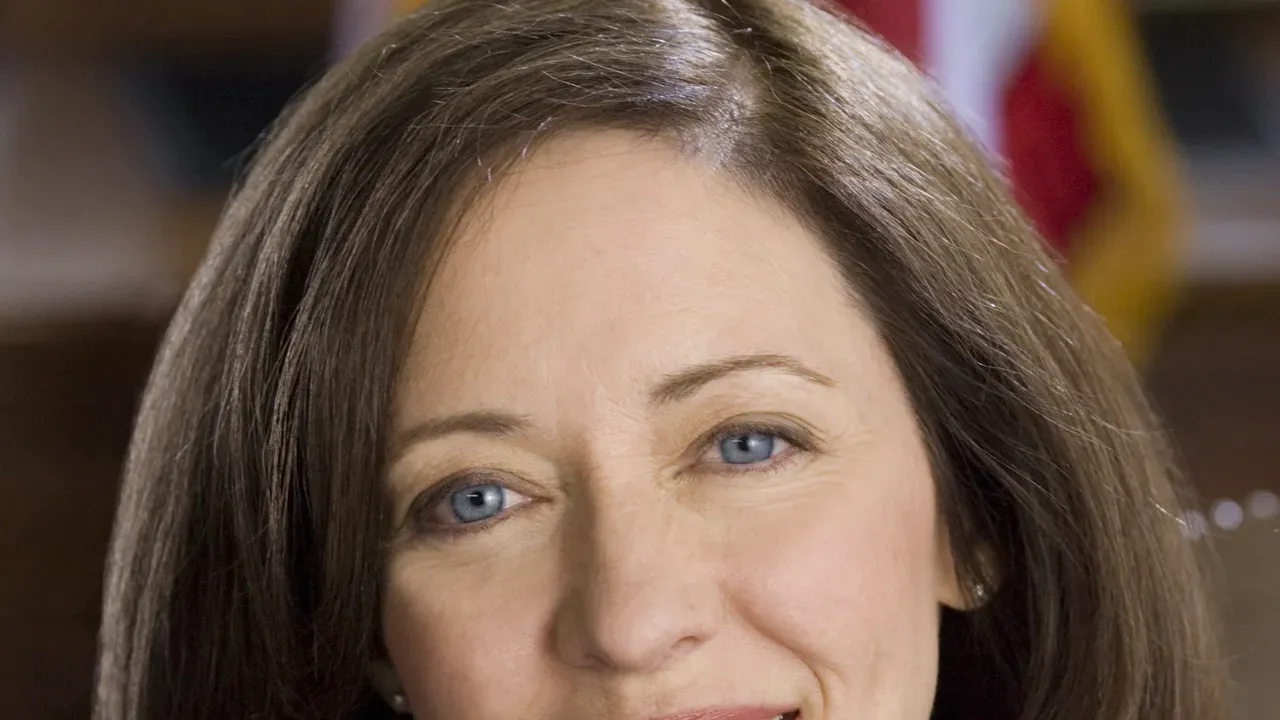
The photograph is the official Senate portrait of Maria Cantwell from the 110th Congress, made for her office and released into the public domain via Wikimedia Commons. The lead crop is a horizontal band of that vertical frame: head and shoulders, black jacket, gray ground. She is not at a microphone on Wednesday. The principles are not in her hands. The face is the senator who asked whether anyone had seen something else. The something else was not in the frame either. It was the penalty, and the interview did not print it.



