The brownout a local model dies in is not the spike a power strip stops
A buyer guide to sine-wave UPS battery backups for a desk that leaves llama.cpp, Ollama, LM Studio, or ComfyUI running overnight. The shop cards are an APC BR1500MS2, a CyberPower CP1500PFCLCD, a CyberPower CP1000PFCLCD, and an APC BR1000MS. The watt rating is the ceiling. Artificial Examiner has not bench-tested these units. The links are affiliate.
TORONTO — October 5, 2026
A power strip is a clamp for a spike. A brownout is a voltage that sags and stays sagged. A two-second outage is a voltage that is gone. The overnight job does not care which of those the strip was built to stop. llama.cpp, Ollama, LM Studio, a fine-tune, a ComfyUI queue, a half-written checkpoint, a GGUF download that has not finished: any of them dies when the rails drop, and a torn write can leave the file unreadable in the morning.
This morning’s guide was the card. That 16 GB card sits in a tower that has a slot. Yesterday afternoon’s guide was the box without one. That mini PC still has to be plugged into something. The file still sits on a drive until a loader maps it, which was Saturday’s disk guide. The working set on a machine with no discrete card is still system RAM, which was Saturday’s memory guide. The pane you watch the log on is still yesterday morning’s monitor. None of those five is the power that has to stay up while they run.
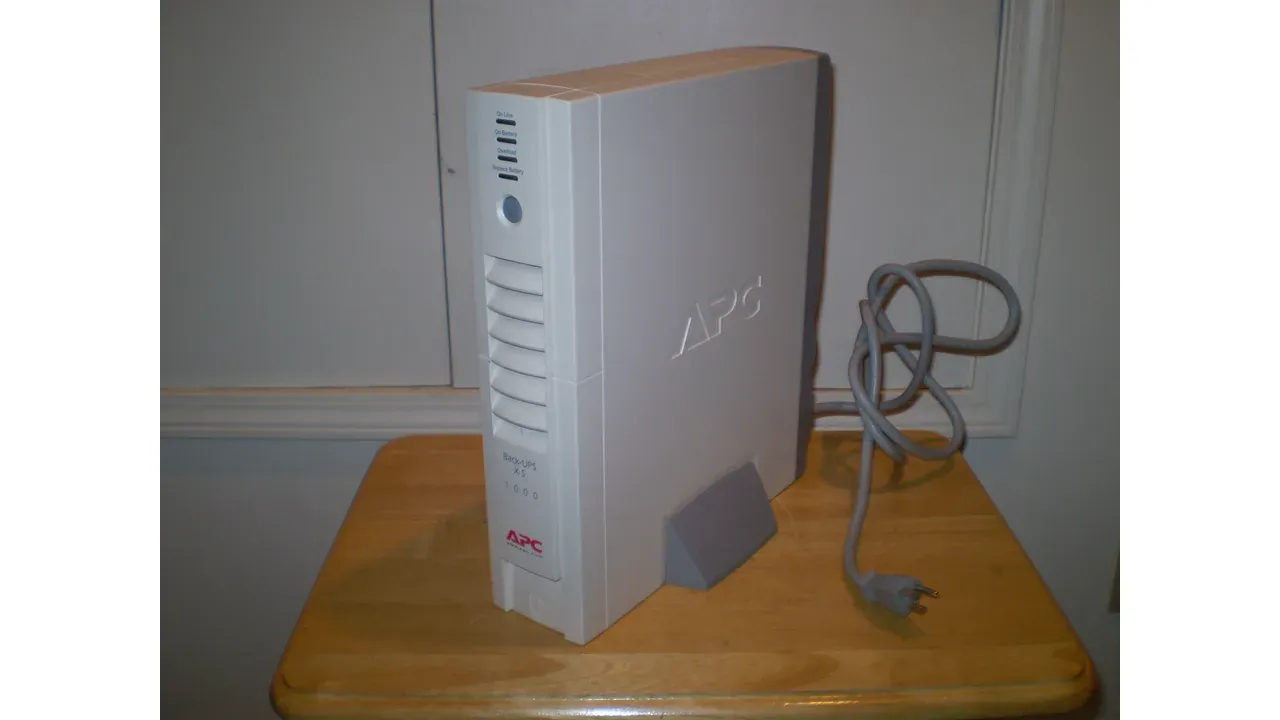
The photograph on this story is an APC Back-UPS XS 1000, model BX1000, taken by Rjluna2 on 26 March 2020. It is not one of the four listings below.
The cards under this story are affiliate links. If you buy through them, Artificial Examiner may earn a commission. Artificial Examiner has not bench-tested these battery backups. There is no runtime in this piece that this desk measured, because this desk did not put a meter on a job and did not pull the plug on any of them.
The strip wants a spike. The model wants the rails to stay up through a sag and through a blink, and then a clean shutdown if the blink becomes the night.
Two ceilings, and a meter you still have to read
Treat the next sections as planning arithmetic, not as a timed test from this desk.
A UPS listing prints two ceilings. One is VA. One is watts. The load you have is the number on a plug-in meter while the job is actually running, on the computer and on the monitor, added together. This morning’s card guide did not print a supply wattage for those cards, and this desk did not meter a tower for this one. The watts below are placeholders so the division is visible. They are not a reading.
Take 380 watts on the tower and 25 watts on the monitor. The sum is 405 watts. A 1500 VA headline does not tell you whether 405 fits. The watt rating does.
900 watts on the APC BR1500MS2 listing means 405 is 405/900 of that ceiling, which is 0.45. 1000 watts on the CyberPower CP1500PFCLCD listing means 405 is 0.405 of that ceiling. 600 watts on either 1000 VA listing means 405 is 0.675 of that ceiling. All three sit under the printed watt rating. A meter that instead read 700 watts would still be under 900 and under 1000, and it would be over 600. The 1000 VA number on the front would not have caught that. 700 is under 1000 only if you mix the units. 700 watts is over a 600 watt rating.
The VA ceiling is the other one. Watts divided by the power factor is VA. A power factor of 1 means the VA equals the watts. A power factor of 0.6 means the VA is the watts divided by 0.6. 405 watts at a power factor of 0.6 is 675 VA. That still sits under a 1000 VA rating and under a 1500 VA rating. We did not measure a power factor. The division is the plan. The meter is the input you still have to take.
An active-PFC supply is built to draw current in step with the voltage. That is why its power factor is usually high, and why the watt rating is the ceiling a buyer of that supply hits first. 900 divided by 1500 is 0.6. That is the pair the BR1500MS2 title prints: 900 W on 1500 VA. 1000 divided by 1500 is two thirds. That is the pair the CP1500PFCLCD title prints. CyberPower’s spec sheet for that model also prints an output power factor of 0.7. Seven tenths of 1500 VA is 1050 watts, which is not the 1000 watts printed on the same sheet. We are not choosing between those two cells. The ceilings you stay under are the VA and the watts the sheet names.
The CP1000PFCLCD sheet prints an output power factor of 0.6, and 600 divided by 1000 is 0.6. Those two cells agree. The Amazon product-information table on that listing does not agree with the rest of the page. It prints an output voltage of 230 volts. The overview on the same page prints 120 volts. The connector cell says NEMA 5-15P. The maker sheet prints a nominal input of 120 VAC and an on-battery voltage of 120 VAC, plus or minus 5 percent. We are carding the 120-volt unit the title and the sheet describe. We are not treating the 230-volt cell as the product.
Why the wave shape is the other spec
A basic battery backup can put a stepped approximation of a sine on the outlets while it is on the battery. An active-PFC supply can refuse that shape. The job stops in the handoff, or the supply hums and drops the rail, and the minutes left on a chart never get used. Both CyberPower sheets say Active PFC Compatible: Yes, and both print the on-battery waveform as Sine Wave. The BR1500MS2 product description says the output is pure sine so active-PFC supplies run as designed. The BR1000MS description says pure sine wave and calls the topology line-interactive. Those are their sentences. This desk did not put a scope on any of the four.
The outlets are not all the same outlet. Battery-and-surge outlets are the ones that hold the computer and the monitor through the outage. Surge-only outlets go dead when the wall does. CyberPower’s own FAQ says the computer, the monitor, and any external drive that still has to finish a write go on the battery outlets. The same FAQ names a laser printer, a space heater, and a vacuum among the loads that void the warranty. A graphics tower is not on that list. A graphics tower that draws more watts than the rating is still an overload. The sheet’s alarm list includes overload. We did not hear one.
A sag is not an outage
A standby unit passes the wall through until the voltage leaves a window, then it switches to the battery. A sag that stays inside the window is not corrected. The battery is spent on the outage. The transfer is a gap at the start of that outage.
A line-interactive unit adds automatic voltage regulation. CyberPower’s feature line says a line-interactive UPS has an autotransformer that regulates low voltages, and the example it gives is brownouts, and overvoltages, without having to switch to battery. The spec table under that prose is narrower. Both sheets print Automatic Voltage Regulation as Single Boost, and both print under/over-voltage correction as +11.5 percent. Single boost is a raise for a low line. We are not reading +11.5 percent as a trim for a high line, and we are not reading the feature sentence as a second spec. A buyer who needs the high line pulled down should read that cell before trusting the prose.
The APC listings claim AVR in the title or the bullets. The BR1000MS bullet says auto voltage regulation boosts low and trims high. The BR1500MS2 product description says AVR corrects low and high voltage without draining the battery. Schneider’s product page for the BR1500MS2 says AVR corrects voltage variations. None of those lines prints a percentage. We did not measure a sag.
The transfer is still there when the wall actually drops. The APC FAQ on both Back-UPS Pro pages says a typical transfer time of 6 ms to 10 ms. The BR1500MS2 product description also says the unit switches “in as little as 8 milliseconds.” Those are not the same sentence. Each CyberPower sheet prints a typical transfer time of 4 ms. A two-second outage is long next to any of those figures. The transfer is the gap at the start of it. If the supply holds across the gap, the job continues on the battery. If it does not, the job dies in the gap, and the chart never starts. We did not time a transfer.
The minutes live on a chart
The minutes you plan with come from the maker’s runtime chart at the load you measured. They do not come from the VA on the front of the box.
CyberPower prints two points and then a warning. For the CP1500PFCLCD the sheet says 2.5 minutes at full load and 10 minutes at half load. The Amazon FAQ on that listing repeats that pair, and says the LCD shows an estimate from the load during the outage. For the CP1000PFCLCD the sheet says 2 minutes at full load and 6 minutes at half load. The Amazon FAQ repeats that pair. The product-information table on the same CP1000 page also says Runtime: 3 minutes, and it does not name the load. Three minutes is not two, and it is not six. We are not averaging them. The note under CyberPower’s curve says the runtimes come from testing fully charged new batteries at normal operating conditions, and that the curve is approximate and varies with battery age, the charge at the test, and the environment. Half load and full load are the sheet’s labels. This desk did not read a watt figure off that curve, and it did not redefine half load as a watt number the sheet did not print next to the minute.
The APC pages disagree with themselves in the other direction. The BR1500MS2 bullet says up to 73 minutes of runtime at 100 W. The product-information table says Runtime: 4 minutes, and it does not name the load. The BR1000MS bullet says up to 42 minutes at a 100 W load. The table says Runtime: 3 minutes, and it does not name the load. One hundred watts is the load the bullet names. It is a small load next to a tower that is in the middle of a job. Schneider publishes a runtime graph for the BR1500MS2. This desk opened that page and did not take a minute off it. The 73 and the 42 are listing claims at a load the bullet names. The 4 and the 3 are cells that do not name one. None of them is a measurement from this desk.
The USB port is the shutdown, not the runtime
A two-second blink is a battery problem, if the transfer holds. An outage longer than the chart is a shutdown problem. A half-written checkpoint and a half-finished GGUF download want the operating system to close them. They do not want the cell to hit empty in the middle of the write.
The program that does that listens on a data port. The names a desk will meet are NUT, apcupsd, PowerChute, and PowerPanel. They are not the same program, and this desk did not install any of them.
CyberPower’s sheet says the data port is a HID-compliant USB port, and the box list on both model pages includes a USB A-to-B cable. The CP1500 sheet names PowerPanel Business. The CP1000 sheet names PowerPanel Personal, and the download list on that page includes Windows, Mac, and Linux builds. CyberPower’s FAQ says PowerPanel is not required for surge protection or for the battery backup itself, and that installing it is what adds an automatic shutdown during an outage. That is the maker’s claim. We did not run the installer.
Schneider’s unboxing FAQ for the BR1500MS2 says the literature kit includes a communication cable, part AP9827, for a native connection to a computer or for PowerChute Serial Shutdown. That is a named cable and a named program. It is not a sentence about NUT. Both APC Amazon pages also carry an image whose alt text reads “Powerchute software.” The bullets under those titles do not name the program. The BR1000MS bullets do not name a cable. Read the manual in the box you receive before you assume the BR1500MS2 cable is in the BR1000MS box.
NUT, which is Network UPS Tools, and apcupsd are the open-source programs a Linux machine uses when the vendor program is not the one you want. Whether either one sees these four units is a software fact this desk did not test. A HID USB port and a serial-shutdown cable are not the same socket. Match the program to the port the sheet names.
The cell is a wear item
Every listing here is a sealed lead-acid battery, and every listing says you can replace it. None of them says the cell is permanent. How many years you get depends on how often the unit goes to battery and how hot the room is. The year-count on a table is the cell the page printed. It is not a count of the brownouts on your street.
The BR1500MS2 FAQ says the internal battery has a lifespan of up to 5 years, depending on usage and maintenance, and names the replacement APCRBC163. The product-information table says Battery Average Life: 5 years, and Battery Charge Time: 16 hours. Schneider’s unboxing FAQ says the battery ships disconnected, under a Department of Transportation rule, and that you connect the red lead before the unit will run. A unit that arrives silent may be that step. We did not open one.
The BR1000MS FAQ uses the same “up to 5 years” sentence and names the replacement APCRBC160.
The CP1500 sheet says the battery is user-replaceable and not hot-swappable, with a typical recharge of 8 hours. The cartridge on that sheet depends on the serial number: RB1290X2 when the serial begins with CXX, and RB1280X2B when it begins with CR9, CXF, or CQC. The Amazon FAQ names only RB1290X2. Read the serial before you order the cartridge. The warranty line on the sheet is 3 years and includes the batteries.
The CP1000 sheet names one cartridge, RB1290, user-replaceable, not hot-swappable, typical recharge 8 hours. The Amazon table says Battery Average Life: 3 years. The warranty line includes the battery for 3 years. Five years on an APC table and three years on a CyberPower table are listing cells. They are not a test.
What the four listings are
Other battery backups exist. Some are standby. Some put a stepped wave on the outlets. Some are rackmount. These four are the listings we can attach to a real Amazon Associates tag, threadandfade-20. We are not ranking them against each other or against any unit we cannot link. There is no price in this piece.
One unit is the APC BR1500MS2 Pure Sine Wave UPS Battery Backup & Surge Protector | 1500VA/900W Back-UPS Pro sinewave UPS for PC, Gaming, electronics. 10 Outlets. USB-C charging. UL & Energy Star certified. The short name is the BR1500MS2. The product-title line is the Pure Sine Wave sentence. The differentiator under it is the 1500VA/900W sentence. The model number and the manufacturer part number both say BR1500MS2. The description calls it a line-interactive UPS. A bullet says 10 outlets, 6 with battery backup and 4 surge-only, plus coax and Ethernet protection, and a user-replaceable battery, APCRBC163. The product-information table says 900 watts, 120 volts, tower, 10 outlets, surge protection 1080 joules, and a 3-year manufacturer warranty. The overview dimensions say 15 inches deep, 4.4 inches wide, and 11.9 inches high. A second dimension line on the same page says 14.49 by 3.94 by 10.24 inches. We are not picking a ruler. When this desk opened the listing on 5 October 2026, the availability line said In Stock and the page offered Add to Cart. Those lines are inventory. They will move. They are not a spec.
The second unit is the CyberPower CP1500PFCLCD PFC Sinewave UPS Battery Backup and Surge Protector | 1500VA/1000W, 12 Outlets, AVR, Mini Tower, UL Certified. The short name is the CP1500PFCLCD. The title says 1500VA/1000W, 12 outlets, AVR, mini tower. A bullet says 6 battery-and-surge outlets and 6 surge-only outlets, a NEMA 5-15P plug on a 5-foot cord, and two USB charge ports. The item model number on the Amazon table is CP1500PFCLCDA, with a trailing A the maker page’s title does not carry. We are carding the listing. We are not treating the A as a second product. The maker sheet says line interactive, sine wave on battery and on AC, 6 and 6 outlets, active PFC compatible, and a 3-year warranty that includes the batteries. The Amazon tech table on the page we opened is short: 14 by 3.9 by 11 inches, 24.9 pounds, two 12 V batteries required. It does not print the wattage. The title does. When this desk opened the listing on 5 October 2026, the availability line said In Stock and the page offered Add to Cart. Inventory, not a spec.
The third unit is the CyberPower CP1000PFCLCD PFC Sinewave UPS Battery Backup and Surge Protector | 1000VA/600W, 10 Outlets, AVR, Mini-Tower, UL Certified. The short name is the CP1000PFCLCD. The title says 1000VA/600W and 10 outlets. A bullet says five battery-and-surge outlets and five surge-only, and it says the screen tilts up to 22 degrees. The maker sheet says the screen tilts up to 17 degrees. We are not averaging 22 and 17. The item model number is CP1000PFCLCDA. The maker page’s title does not carry the A. Same reading as the 1500 VA CyberPower. The Amazon table says 600 watts, 10 outlets, form factor mini-tower, battery average life 3 years, runtime 3 minutes, and then an output voltage of 230 volts next to an input voltage of 120 volts. The 230-volt cell is the one described above. The overview dimensions say 10.24 inches deep, 3.94 inches wide, and 9.7 inches high. A second line says 10.4 by 3.9 by 9.1 inches. The maker sheet’s inch dimensions are 3.94 by 9.7 by 10.24, which matches the overview and not the second line. When this desk opened the listing on 5 October 2026, the availability line said In Stock and the page offered Add to Cart. Inventory, not a spec.
The fourth unit is the APC UPS 1000VA/600W Pure Sine Wave UPS for Computer, Electronics, BR1000MS | Back-UPS Pro Sinewave UPS for PC, gaming & home offices. Surge protection, AVR, USB-C charging, User-replaceable battery. The short name is the BR1000MS. The product-title line carries the 1000VA/600W and the model. The differentiator is the Back-UPS Pro sentence. The model number and the manufacturer part number both say BR1000MS. The item type on the table says line-interactive UPS. A bullet says 6 battery backup outlets and 4 surge-only, plus coax and Ethernet. The table says 600 watts, 10 outlets, tower, and runtime 3 minutes. It also says the power plug type is Type A, 2 pin, and the connector type is NEMA 5-15R plus USB-A and USB-C. A 2-pin cell and a NEMA 5-15 cell are not the same cord. The UPC cell prints two numbers, 810030051725 and 731304335382. The overview dimensions say 14.5 inches deep, 3.9 inches wide, and 10.2 inches high. A second dimension line says 5 by 5.5 by 14.5 inches. We are not picking a cord or a ruler the page could not keep consistent. When this desk opened the listing on 5 October 2026, the availability line said In Stock and the page offered Add to Cart. Inventory, not a spec.
Which listing to read for which ceiling
Choose the BR1500MS2 when the title you want is the APC 1500 VA / 900 W pure-sine tower, and when 900 watts is the ceiling your meter still sits under. The part number to match is BR1500MS2. Leave the 73-minute line out of the choice until you have read Schneider’s runtime graph at your wattage. Leave the table’s “4 minutes” out of it too. That cell does not name a load.
Choose the CP1500PFCLCD when the title you want is the 1500 VA / 1000 W CyberPower, with 12 outlets and a sheet that already prints 2.5 minutes at full load and 10 minutes at half load. The model field to notice is CP1500PFCLCDA. The maker page you are matching is CP1500PFCLCD. The 0.7 power-factor cell and the 1000 watt cell do not multiply out to the same number. Do not pretend they do. Size to the watts and the VA the sheet names, and then read the curve, which the sheet says is approximate.
Choose the CP1000PFCLCD when 1000 VA and 600 watts are the ceilings your meter sits under, and when you have already thrown out the 230-volt cell. The model field is CP1000PFCLCDA. The sheet’s full-load point is 2 minutes and the half-load point is 6 minutes. The Amazon runtime cell says 3 minutes. The screen-tilt bullet says 22 degrees and the sheet says 17. None of those disagreements raises the watt rating.
Choose the BR1000MS when the title you want is the APC 1000 VA / 600 W pure-sine tower. The part number is BR1000MS. The replacement the FAQ names is APCRBC160. If the cord on the unit you receive is not a grounded three-prong plug, the Type A cell and the NEMA cell were not a typo you can ignore. Stop and look. The 42 minutes at 100 W is the bullet. It is not your job.
A VA number we did not measure against a meter is the wrong reason to choose. A review on the page that liked a weekend outage is the wrong reason too. The units are the listings. Artificial Examiner has not opened these boxes, has not metered them, has not loaded a GGUF behind them, and has not run a shutdown program against them. The blurbs under the story say that in shorter form.
The buttons under the article go to those four Amazon listings with our Associates tag, threadandfade-20. They are advertisements. The commission, if a purchase happens, does not pick the ceiling. The watts your meter shows, on the tower and on the monitor, while the job is actually running, do.
This story includes affiliate links. If you buy through them, Artificial Examiner may earn a commission. That does not change the reporting. See our affiliate disclosure.