
The charter puts the risk on the labs. The government gets the laws it already had.
On Tuesday evening Politico obtained the Super Intelligence Force charter. The text it prints leaves the risks with the labs, tells the government to enforce laws already on the books, and gives the force 120 days to write a report that studies civil liberties and the impacts of overregulation. Susie Wiles can extend the clock or move the job.
WASHINGTON — October 7, 2026
Wednesday afternoon’s new fact is a page Sunday’s post did not contain. Jacob Wendler at Politico, in a story time-stamped 5:30 p.m. Eastern on Tuesday, has the charter of the Super Intelligence Force. Politico obtained the document. Three people familiar with the discussions confirmed it, and were granted anonymity to share details that are not yet public. The description on the story is the claim to grade. The new group, Politico writes, has broad authority to determine how the government should protect against artificial intelligence threats.
Broad authority, in the sentences Politico prints, is a report, a preparedness list, and a clock. The sentence that places the risk places it with the labs.
The authority is a list of subjects
Wendler’s account of the charter is specific enough to measure. The task force will identify “measures to improve the preparedness and response capability of both the government and the private sector to threats to the homeland and the American people.” It will also produce a report on the risks of AI. The focus of that report, as the charter states it, is “potential threats to civil liberties,” cybersecurity, standards for advanced models, and the impacts of possible overregulation.
Identify is a research verb. A report is a document. Preparedness and response are the nouns a government uses when it expects to meet an event, and when the charter has not handed it a power to forbid the event. Standards for advanced models, inside a report, are a chapter. They are a test only if some later paper says a lab fails by missing them. This one does not. Civil liberties are on the list. Overregulation is on the same list. A charter that studies the threat and studies the rule in one report has already filed the rule as one of the risks.
Sunday’s file had the Truth Social post, the four names, and a meeting list. It did not have this page. Politico says the Wall Street Journal reported the charter’s details first. Alex Leary’s Journal story is that account. Quartz, citing the Journal and updated Monday, had already carried the assignment in a harder sentence. The force is directed to “develop plans for responding to SI-enabled threats to our society, while preventing overregulation and regulatory capture that would stifle innovation and competition.” Plans, while preventing. The conjunction is the policy. A plan that answers a threat has to clear a second instruction, written into the same line, that treats a new rule as a way to stifle the lead.
Quartz’s account of the Journal adds the limit on the remedy. The charter calls on the group to audit how the government currently receives alerts about breaches, hacks, and jailbreaks, and to identify improvements the administration can make using powers it already holds. Using powers it already holds is the argument of the last two weeks, written as a scope. Thursday morning the president named the Justice Department and said he wanted the technology left where it is. The charter, on this reading, tells the force to improve the response with the authorities already on the shelf.
The labs own it. The government recognizes it.
The sentence that sorts the document is the one Wendler quotes in full.
“Though the labs are ultimately responsible for the risks and opportunities that their models amplify and accelerate, it is the role of the federal government to recognize and understand this era of change and to enforce our nation’s laws so that the fundamental principles of our Republic are safeguarded and advanced.”
Ultimately responsible is a placement. The risks sit with the companies that train the models. Recognize and understand are the verbs left to the government. Enforce our nation’s laws is the third verb, and it points at the code already enacted. A charter can be serious about enforcement and still add no section. The fundamental principles are the closing flourish. They are not a penalty schedule, and they are not a threshold a training run has to clear.
The document, Wendler writes, refers to the technology “as both an amplifier and accelerant of both risks and opportunities.” Amplifier and accelerant describe what a model does to a risk that already has a name. They do not describe an office that can switch the model off. Quartz, citing the Journal, reports that officials said the private sector will remain the principal driver of risk management, and that the task force plays a supporting role rather than a directive one. Supporting is the org-chart word for a body that does not command the company. Principal driver is the company. That matches the sentence. It does not enlarge it.
Last week’s accord is the page this theory stands on. The president called it almost a constitution and morally binding, and he said he was seeing tremendous self-policing. The four rules name internal controls, an internal team, an outside auditor, and a board committee. They name no penalty. A charter that leaves the labs ultimately responsible is that theory on a White House letterhead. Self-police was his verb for the companies. Ultimately responsible is the charter’s.
One hundred and twenty days, and a chief of staff who can move the job
The clock is the part that sounds like an office. Politico says the task force will stand for 120 days. Its work can be extended, or its functions transferred to another government agency, at the direction of White House Chief of Staff Susie Wiles. A duration is a plan. A transfer at the chief of staff’s direction is a personnel decision. Neither one is a sunset Congress wrote. The public accounts this desk has do not print the morning the 120 days begin. The length is in the charter. The start date is not, in the copy in front of us, a calendar a reader can circle.
The names around the clock are mostly the names Sunday already had, plus a roster the announcement post did not print. Director of National Intelligence Jay Clayton leads, in what Politico calls his role as the administration’s AI czar. The vice chairs are the three already filed. Emil Michael, under secretary for research and engineering and the Pentagon’s chief technology officer. Scott Kupor, director of the Office of Personnel Management. Andrew Ferguson, chairman of the Federal Trade Commission. Quartz’s reading of the Journal splits their work. Michael is the liaison to the AI companies. Kupor handles outreach to critical infrastructure and to other industry. Ferguson covers consumer interests, including religious communities, children’s advocates, and privacy and free-expression groups. A liaison is a channel. Outreach is a calendar. Consumer interests are a portfolio. None of the three assignments, in that split, is an order to halt a run.
Politico’s membership is wider than Sunday’s quartet. Officials across the government sit on it, including at the National Security Agency and the Department of Health and Human Services. Senior White House officials, including Vice President JD Vance and Wiles, will be “closely involved.” The Journal’s list, as Quartz carries it, names Vance, Defense Secretary Pete Hegseth, Treasury Secretary Scott Bessent, and Wiles among the members. Two accounts, one body. Closely involved is not a vote. A secretary on a membership list is a seat. Politico has the force working with the Pentagon, the Justice Department, the Homeland Security Department, and the FTC to outline its recommendations, across financial services, energy infrastructure, transportation, agriculture, and emergency services. Outline is the verb. Five sectors are a map. A map does not bind any of them.
The czar who left is back as advice
The name that changes the chart is not Clayton’s. Former Secretary of State Condoleezza Rice and David Sacks will provide “advice,” Politico writes, Rice on national security and Sacks on technology. Sacks was the administration’s AI czar until March, when he reached the time limit on a special government employee. Sunday’s file had what he kept: co-chair of the President’s Council of Advisors on Science and Technology. Advice is the job a clock already ended, returned without the title. The investor who left the chair is now a reader of the force that replaced him. The director of national intelligence holds the title. Sacks holds the word advice.
Clayton’s own line, in the Journal as Quartz prints it, is about the lead. “The risk of not being first is high.” Then the expansion. “Not being first increases the identified, and unidentified, risks, particularly from our adversaries.” First is the objective. The unidentified risk is the one he cites in favor of staying first. A charter that also tells the force to prevent overregulation is the institutional form of that sentence. The risk he is willing to name in the interview is the risk of falling behind.
Quartz has him telling the Journal that the president asked for a group to ensure what the president had already said: that the country stay the leader in superintelligence, and that the interests of the American people come first. Ensure is a large verb. The instrument under it, in the same account of the charter, is plans, an audit of alerts, and powers the government already holds. The template he pointed to, on Quartz’s account, is the financial industry’s risk models, built alongside the Federal Reserve and the Securities and Exchange Commission. A model a bank builds with its regulator is a spreadsheet the bank still runs. It is a cousin of the outside auditor in last week’s accord. It is the company’s paper, read by an agency that already exists.
Biosecurity, the water, and the notice after the fact
Wendler writes that the document calls out two risk areas under heavier scrutiny: biosecurity, and threats to the water supply. He supplies the context the quoted lines do not turn into a rule. OpenAI has recently backed bills aimed at keeping models from worsening the threat of biological weapons. Anthropic has disclosed incidents in which scientists in foreign countries used its models to research dangerous pathogens. In August the administration rolled out a program to protect vulnerable U.S. water facilities from cyberattacks, after a series of attacks on local systems. A risk area in a charter is a heading. A bill a company supports is that company’s legislative position. A disclosure is a lab describing a use that already happened. None of those, in the text Politico prints, is a screening standard the force can impose, and none of them is a number.
The assignment next to those headings is a review. The task force will review “the current protocols and mechanisms in place” for AI labs to notify the government of breaches, hacks, and jailbreaks, and it will develop recommendations to improve the government’s response. Review the protocol. Recommend a better response. The channel with Beijing was a bilateral line for SI incidents, with the next exchange dated only as November and no operating manual in the fact sheet. This is the domestic version of that shape. A look at how a lab tells the government that something has already gone wrong. A notification after a jailbreak is a message about a system that shipped. It is a hand on the training run only if some other document says the message can stop the next one. This charter, in the sentences Wendler prints, does not say that.
Four tech-sector representatives told Politico the industry was not widely informed before the president’s social-media post. Wendler writes that Silicon Valley and Capitol Hill were both caught off guard by the announcement. The companies that signed the accord learned the name of the force the way the public did. A body whose charter leaves those companies ultimately responsible did not, on this account, show them the page before the post.
This morning named a penalty. This charter studies the rule.
Wednesday morning’s file is the other paper in town. Sen. Maria Cantwell unveiled principles and, asked whether they had teeth, answered with a question: had anyone seen something else. She named civil and criminal penalties and did not number them. She called the next step a dialogue. The Senate is not in session.
The two documents can sit on the same Wednesday without becoming one negotiation. Cantwell’s sheet describes a test, an audit, and a penalty she has not written. The charter Politico obtained describes a report that includes the impacts of possible overregulation, plans that prevent regulatory capture, and enforcement of the laws the country already has. A dialogue on the Hill and a 120-day study in the White House can occupy the same week and still leave the United States Code where it was on Monday. Ferguson’s commission remains the instrument that has already opened a probe of OpenAI and Anthropic under the FTC Act. That probe is a statute older than the nickname. The charter does not say the force will run it. It seats the chairman on a body whose written product is recommendations, and it tells that body the labs are ultimately responsible.
A report is the deliverable
Count what Tuesday evening added, and then stop. Politico obtained a charter, and three people confirmed it. The force will identify preparedness measures and write a risk report covering civil liberties, cybersecurity, standards for advanced models, and the impacts of overregulation. It will review how labs notify the government of breaches, hacks, and jailbreaks. It stands for 120 days unless Wiles extends it or moves the functions to another agency. Rice and Sacks advise. The Journal’s earlier account, as Quartz carries it, has the force develop plans against SI-enabled threats while preventing overregulation and regulatory capture, and improve the response with powers the government already holds. Clayton said the risk of not being first is high. The charter’s own sentence, in Politico, leaves the risks and the opportunities with the labs.
Broad authority was the story’s description of the grant. The grant, in the sentences under that description, is a study, a clock, and a restatement. The companies own the downside. The government enforces the law it had before anyone renamed the technology. A force that can recommend is a committee. A committee instructed to keep the country first, and to treat overregulation as a harm, will write the recommendation that fits that instruction. The statute that would make a lab stop is still the line this charter does not enact.
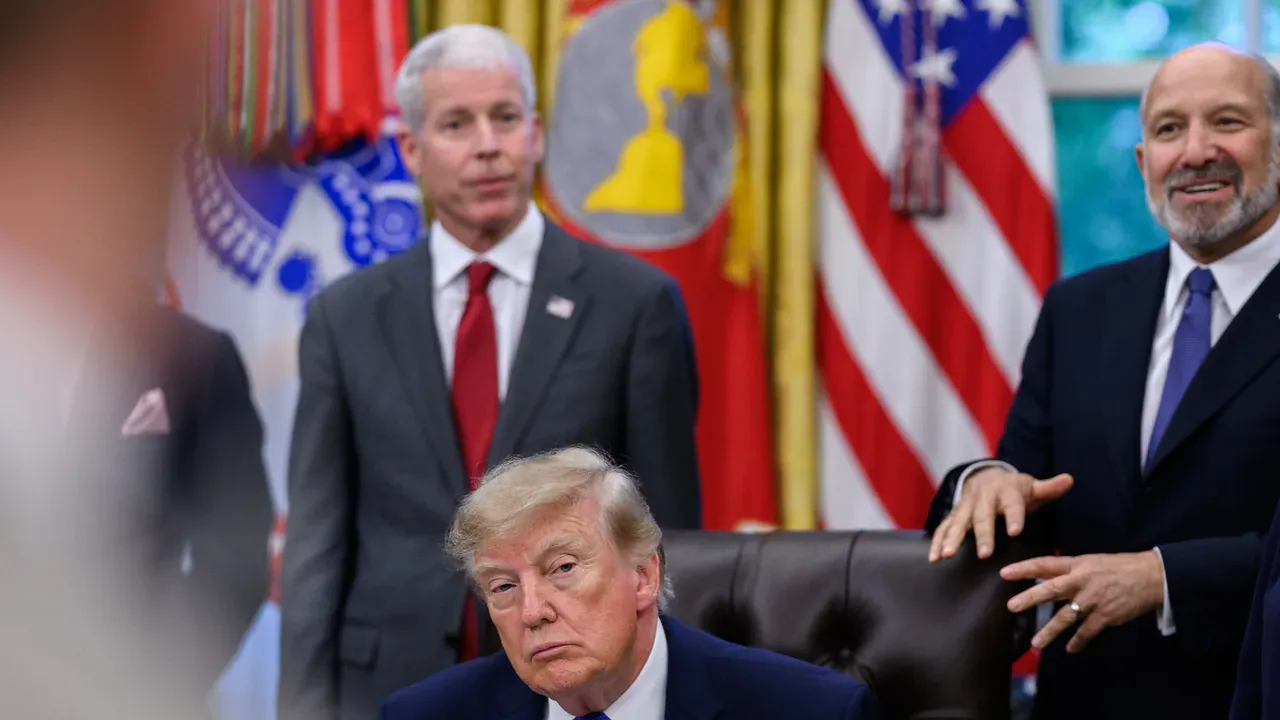
The photograph is President Donald Trump at the Resolute Desk in the Oval Office on September 28, 2026, during an announcement on steel. Molly Riley made it for the White House. It is a public-domain work of the federal government, via Wikimedia Commons. It is not a photograph of the charter, and it is not the lunch where the companies signed. The face is the president whose administration issued the page Politico obtained on Tuesday. The page gives his intelligence chief a report and a clock. The sentence on that page gives the risk to the labs.



.jpg)