
The drive a local model maps is not the portable disk a cable feeds
A buyer guide to internal M.2 NVMe SSDs, PCIe 4.0, in the 2 TB class, for a desktop or mini PC that loads GGUF weights, a Hugging Face cache, and ComfyUI checkpoints from the slot. The shop cards are a Samsung 990 PRO, a Samsung 990 EVO Plus, a WD_BLACK SN850X, a Crucial T500, and a Kingston NV3. Saturday's portable shelf is a different drive. Artificial Examiner has not bench-tested these modules. The links are affiliate.
TORONTO — October 7, 2026
A desktop that keeps a GGUF mapped, a Hugging Face cache on disk, and a ComfyUI checkpoint in a models folder is reading an internal drive. The module is an M.2 NVMe card screwed to the motherboard, on that board’s own PCIe link. There is no cable to pull, and the volume does not vanish because a bag moved. Saturday’s guide was the disk that does both of those things.
That portable shelf is a USB solid-state drive. It is the overflow a laptop boot volume cannot hold, and the port, not the sticker, sets the speed. This guide is the other disk: the internal M.2 a desktop or a mini PC loads the weights from. Same files. Different link. A cable you can lose is not a slot you have to unscrew.
This morning’s guide was the supply a local model draws. That sticker is a wattage at the 12-volt rail. The drive is the file the loader reads before the card has a job to spend those watts on. Once the file is in memory, the working set is still system RAM, which was Saturday’s memory guide. A faster slot does not add a gigabyte the loader can use. Sunday afternoon’s mini PC already shipped with a drive in it. That box is the machine. This guide is the module you put in the slot when the module it shipped with is full, or when the board has a second M.2 and you mean to use it.
The drives under this story are affiliate links. If you buy through the cards, Artificial Examiner may earn a commission. Artificial Examiner has not bench-tested these modules. There is no stopwatch reading in this piece, because this desk did not time a copy. There is no price in this piece.
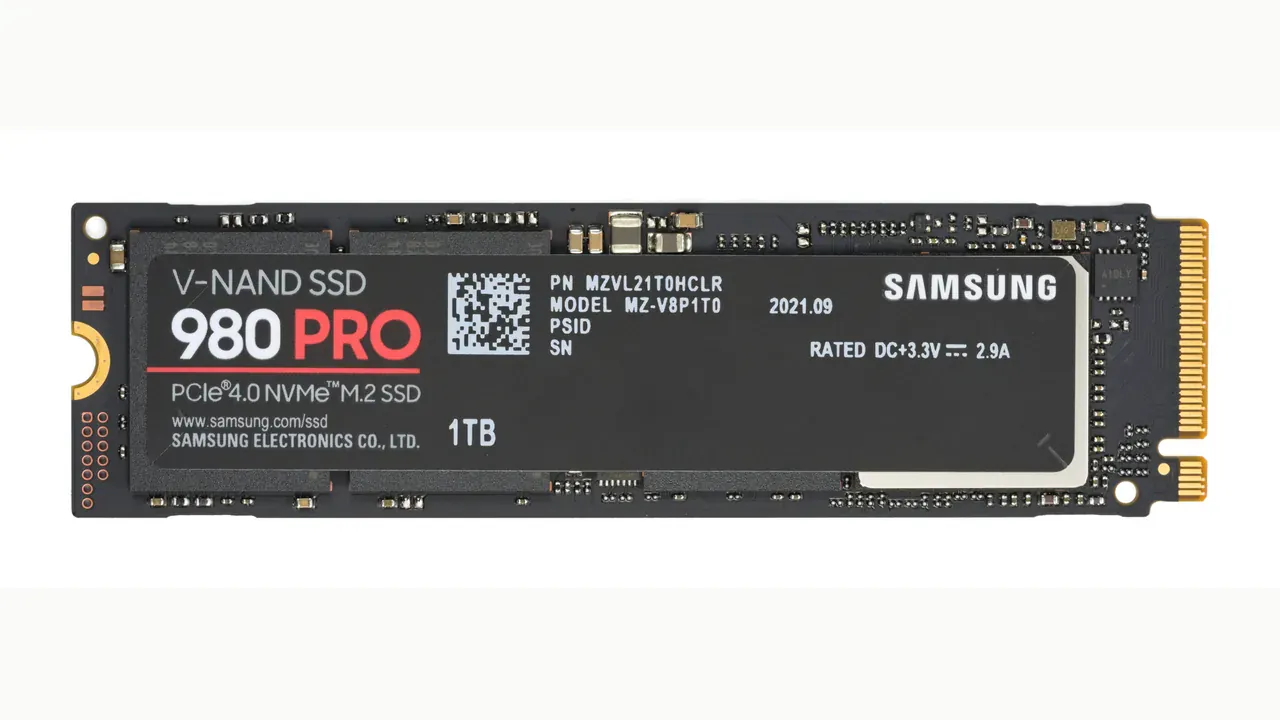
The photograph is a Samsung 980 PRO, 1 TB, taken by D-Kuru on 26 March 2022 and released under CC BY-SA 4.0. It is a Commons photograph of that module. It is not one of the listings under this story, and it is not the image on any listing. A 980 PRO is a different product from the 990 PRO.
The sequential sticker is how fast a cold file can enter memory. It is not how fast the model talks once the file is there.
The read that is not the token
Treat the next paragraphs as planning arithmetic, not as a timed copy from this desk. Saturday’s disk guide already set the file sizes: a dense 4-bit GGUF lands on the order of half a gigabyte per billion parameters, and a 70-billion-parameter Q4 file is on the order of 40 GB. Mixture-of-experts files do not shrink to the active count. The hub cache stores the snapshot and the quant if you keep both. This guide does not restate that table. It uses the 40 GB figure as a length, so the sticker has something to divide.
llama.cpp memory-maps the GGUF. You pass the path. Ollama keeps its own store, and OLLAMA_MODELS moves it. A desktop app that hides the path usually exposes a model folder. ComfyUI reads checkpoints from the folder you point it at. A checkpoint is one file the UI reads at the start of a job. This desk is not assigning a byte count to a checkpoint it did not open. The Hugging Face cache is the same variable as Saturday: HF_HOME, or a symlink from ~/.cache/huggingface. On a laptop whose internal drive is the boot volume and is already full, Saturday’s advice was to point that cache at the portable shelf. On a desktop that stays on the desk, point it at the internal volume you will not unplug. The map path is the slot. A portable volume that sleeps mid-read looks like a corrupt model. The file is often fine. The disk is simply gone.
The first read of a cold file is the sequential job. After the working set is in RAM, token generation is not the drive. If the file does not fit, the operating system pages it, and the cell that describes paging is the low-queue random read, not the sequential ceiling. Samsung’s revision 2.0 datasheet for the 990 PRO, read on 7 October 2026, prints a queue-depth-1, single-thread random read of 22K IOPS on the 1 TB, 2 TB, and 4 TB columns alike. The same row’s sequential read is 7,450 MB/s. Those are two cells. We are not averaging them into one speed.
The PCI Express article on Wikipedia, read the same day, puts PCIe 4.0 at 16.0 GT/s with 128b/130b encoding. The x4 throughput on that table is 7.877 GB/s. The x2 throughput is 3.938 GB/s. PCIe 3.0 x4 is also 3.938 GB/s. PCIe 5.0 x2 is 7.877 GB/s, the same cell as PCIe 4.0 x4. PCIe 5.0 x4 is 15.754 GB/s. Sandisk’s own footnote on the SN850X page says 1 MB/s equals 1 million bytes per second. On that definition, 7,450 MB/s is 7.450 GB/s. It sits under 7.877. It does not clear it. The 7.450 is the datasheet applied to the table. It is not a measurement of these five modules.
Applied to Saturday’s 40 GB planning size, 40,000 divided by 7,450 is about 5.4 seconds of sequential payload. The same 40 GB against the 3.938 GB/s of a PCIe 3.0 x4 slot is about 10.2 seconds. Both divisions are the sticker, or the slot’s payload rate, applied to a planning size. They are not a copy this desk timed. A slot wired as PCIe 3.0 x4 is still an M.2 slot. The drive negotiates down. Sandisk’s footnote 3 says the SN850X is backwards compatible with PCIe Gen3, and that Gen4 storage requires a compatible motherboard. Samsung’s 990 PRO footnote 2 says the drive is backward compatible with PCIe 3.0. The sticker does not survive the slower slot. The slot is the ceiling.
A Gen5 socket does not promote every module to Gen5 x4. The 990 EVO Plus datasheet, revision 1.0, October 2024, prints the interface as PCIe 4.0 x4 / 5.0 x2, NVMe 2.0. Those two widths land on the same 7.877 GB/s cell. They are not the 15.754 GB/s cell. A comparison table on the 990 PRO Amazon listing, read the same day, puts a 9100 PRO in the next column at PCIe 5.0 x4 and up to 14,800 / 13,400. That column is a different drive. It is not a card under this story.
The screw, the lid, and the second slot
Sandisk’s compatibility line for the SN850X asks for a computer with an M.2 M-key port that can take an M.2 2280 module. That is the part. A SATA stick in an M.2 shell is a different notch and a different link, and this guide is not that stick. 2280 is 22 mm by 80 mm. Every 2 TB module in this piece, on the maker page or the datasheet this desk read, is that length. Kingston’s NV3 page also lists an M.2 2230, 22 mm by 30 mm, with its own weight row. The Amazon title on the Kingston card says 2280, and the part is SNV3S/2000G. We are not carding the short one.
The lid is the other limit. Sandisk’s 2 TB table for WDS200T2X0E, the part with no heatsink, prints 3.15 by 0.87 by 0.09 inches and 7.5 g. The 2 TB heatsink part, WDS200T2XHE, prints 3.15 by 0.92 by 0.35 inches and 24 g. A motherboard cover plus a sink that is already 0.35 inches tall is how a mini-PC shell does not close. The card under this story is the bare part. The heatsink part is a different model number. Sandisk’s compatibility line marks PlayStation 5 support as the heatsink model only. This guide is not a console guide. It is a reason not to buy the tall module for a laptop or a small box, and not to expect the bare module to be the console part.
A board with one M.2 has one drive. The operating system, the update, and the library share it. Filling it makes the update miserable, which is the same failure Saturday named for a laptop boot volume. A second slot, if the board has one, is the library, and the boot module can stay small. Sunday’s mini-PC guide already said some of those boxes ship with a 1 TB NVMe occupied. Read the slot count on the machine you have before you treat a 2 TB module as spare capacity. If there is no second slot, the 2 TB module is a replacement, and the files have to come off the old one first.
The label is decimal. Samsung’s datasheet footnote says 1 GB equals 1,000,000,000 bytes by IDEMA, and that a portion of capacity may be used for maintenance, so the available capacity can differ from the label. The lineup line prints the 2 TB density as 2,000 GB. Two trillion bytes is about 1,863 GiB before the filesystem takes its slice. Sandisk’s footnote 2 says 1 TB equals 1 trillion bytes, and that actual user capacity may be less. Leave headroom. A volume that is actually full is a bad place to unpack the next snapshot before you delete the old one.
What the five modules are
Other internal SSDs exist. Some are PCIe 5.0 x4. Some are SATA. Some are 2230. This guide’s cards are the five listings we can attach to a real Amazon Associates tag, threadandfade-20, with a photograph Amazon actually served for that ASIN. We are not ranking them against each other, or against any module we cannot link.
One module is the Samsung SSD 990 PRO 2TB. The short name is the 990 PRO. The Amazon title joins that sentence to a differentiator that names PCIe 4.0, M.2 2280, up to 7,450 MB/s, and the part MZ-V9P2T0B/AM. The model number and the manufacturer part number say MZ-V9P2T0B/AM. The UPC cell says 887276657011. The model-name cell says 2TB. We are carding the title and MZ-V9P2T0B/AM. We are not carding the model-name cell as a product name. A style selector on the same page offers “990 PRO” and “990 PRO w/ Heatsink.” The datasheet lineup this desk read lists MZ-V9P2T0BW and MZ-V9P2T0B/AM for the 2 TB. It does not list a heatsink code in that lineup. We are carding the model number on the page. We are not carding the heatsink style.
Samsung’s revision 2.0 datasheet, dated 2023, says client PCs and PlayStation 5, interface PCIe Gen 4.0 x4, NVMe 2.0, Samsung in-house controller, Samsung V-NAND TLC, and a DRAM cache of 2 GB LPDDR4 on the 2 TB column. Dimensions are max 80.0 by max 22 by max 2.3 mm. Form factor M.2 2280. Sequential read and write, up to, are 7,450 MB/s and 6,900 MB/s on the 1 TB, 2 TB, and 4 TB columns. Queue-depth 32, 16 threads, random read is 1,200K IOPS at 1 TB, 1400K IOPS at 2 TB, and 1600K IOPS at 4 TB. Random write on that row is 1,550K IOPS for all three. Active average power on the 2 TB column is 6.1 W read and 5.5 W write. Idle, APST on, is 55 mW. TBW is 1,200 TB. The period is 5 years limited. Footnote 6 says the warranty is the period or the TBW, whichever comes first, and that the endurance test follows JESD218. Footnote 4 says the write figures were measured with Intelligent TurboWrite activated, and that TurboWrite operates only within a specific data transfer size. The datasheet tells you to ask a service center for that size. We are not inventing the window. A model download larger than a window the sheet does not print is not the 6,900 MB/s cell.
Amazon’s read-speed cell says 7450 megabytes per second, and the media-speed cell says 6900 megabytes per second. Those match the datasheet. Amazon’s additional-features cell says 9.8 ft drop resistance, read speeds up to 1050 MB/s, water and dust resistance, and write speeds up to 1000 MB/s. We are not averaging 1,050 and 7,450. A drop-and-water line is a portable drive’s sentence. This listing is an internal module. Amazon’s cache-memory cell says 2 TB. The datasheet’s DRAM cell says 2 GB LPDDR4. We are not reading the capacity as the cache. Amazon’s hard-disk form factor says 2.28 inches, and the form-factor cell says M.2 2280. Amazon’s dimension cell says 3.16 by 0.87 by 0.09 inches. The datasheet’s 80.0 mm edge is 3.15 inches. We are not averaging 3.16 and 3.15. Amazon’s weight cell says 9.07 g. The datasheet table this desk read did not print a weight. A comparison table on the listing prints the 990 PRO random cell as up to 1,600K / 1,550K. 1,600K is the datasheet’s 4 TB random-read cell. The 2 TB cell is 1400K. The comparison table does not split by capacity. We are not promoting 1,600K onto the 2 TB part. The same table’s product-width cell says max 0.09 inches. That magnitude is the 2.3 mm thickness, not the 22 mm width.
Amazon’s warranty cell says 5 Years Manufacturer. The datasheet says 5 years limited, or 1,200 TB written, whichever comes first. When this desk opened the listing on 7 October 2026, the offer this desk could read showed In Stock, ships from and sold by Amazon.com, with free delivery Thursday, October 15, and a quantity line that said only 1 left. Those lines are inventory. They will move. They are not a spec.
The second module is the Samsung SSD 990 EVO Plus 2TB. The short name is the 990 EVO Plus. The Amazon title names PCIe Gen 4x4 and 5x2, M.2 2280, up to 7,250 MB/s, HMB, Intelligent Turbowrite 2.0, and the part MZ-V9S2T0B/AM. The model number and the manufacturer part number say MZ-V9S2T0B/AM. The UPC cell says 887276843674. The model name says 990 EVO Plus. A banner on the page says there is a newer model, a Samsung 990 2TB, part MZ-V9V2T0B/AM. That banner is a different ASIN. There is no shop card under this story for it.
The 990 EVO Plus datasheet, revision 1.0, October 2024, says client PCs, interface PCIe 4.0 x4 / 5.0 x2, NVMe 2.0, Samsung V-NAND TLC, and cache memory HMB, which the sheet spells out as Host Memory Buffer. Dimensions are max 80.15 by max 22.15 by max 2.38 mm. Form factor M.2 2280. On the 2 TB column, sequential read is 7,250 MB/s and sequential write is 6,300 MB/s. The 1 TB column’s sequential read is 7,150 MB/s, not 7,250. Random read is 1,000K IOPS at 2 TB and 1,050K IOPS at 4 TB. Random write is 1,350K IOPS at 2 TB and 1,400K IOPS at 4 TB. Active average power at 2 TB is 4.6 W read and 4.2 W write. Idle, PS3 with APST on, is 60 mW. TBW is 1200 TB. The period is 5 years limited, or the TBW, whichever comes first. Footnote 2 says the drive is backward compatible with PCIe 4.0 x4 and 3.0 x4. Footnote 4 is the same TurboWrite sentence as on the 990 PRO: the write figure was measured with Intelligent TurboWrite on, inside a transfer size the sheet does not print.
HMB is the cache line. It is not a DRAM chip on the module. The 990 PRO 2 TB line is 2 GB of LPDDR4 on the drive. The 990 EVO Plus line borrows host memory. On a box whose RAM is already the working set of the GGUF, those are different sentences. The datasheet does not print how many megabytes the buffer asks for. A customer review on the Amazon page offers a range. That is a review. We are not promoting it into the datasheet. An image caption in the listing’s from-the-manufacturer block calls the drive the DRAM-less type, or HMB. That caption matches the cache line. It does not add a size.
Amazon’s read-speed cell says 7250 megabytes per second. The media-speed cell says 6300, with no unit in the cell this desk read. The data-transfer-rate cell says 7250 megabits per second. A megabit is an eighth of a megabyte. We are not averaging the two units into one speed. Amazon’s hard-disk form factor says 2.5 inches. The form-factor cell says M2. The hardware-connectivity cell says PCIE x 4. The datasheet’s other width is PCIe 5.0 x2. We are not deleting the x2 because the cell printed x4. Amazon’s dimension cell says 3.2 by 0.9 by 0.1 inches. The datasheet’s long edge is 80.15 mm, which is 3.16 inches. We are not averaging 3.2 and 3.16. Amazon’s weight cell says 9 g. The datasheet table did not print a weight. A comparison table on the 990 PRO listing, which includes this module in the last column, prints the 990 EVO Plus random cell as up to 1050K / 1,400K. 1,050K and 1,400K are the datasheet’s 4 TB cells. The 2 TB cells are 1,000K and 1,350K. The comparison table does not split by capacity.
Amazon’s warranty cell says 5 Year Manufacturer. The datasheet says 5 years limited or 1,200 TB written. When this desk opened the listing on 7 October 2026, the offer this desk could read showed In Stock, ships from Amazon, sold by MobileMonster, with free delivery Monday, October 12. Those lines are inventory. They are not a spec.
The third module is the WD_BLACK SN850X 2TB, part WDS200T2X0E. The short name is the SN850X. The Amazon title names M.2 2280, up to 7,300 MB/s read, and up to 6,300 MB/s write. The model number and the manufacturer part number say WDS200T2X0E. The UPC cell says 718037891408. The brand cell and the manufacturer cell say Sandisk. The model name says WD_BLACK SN850X NVMe SSD.
Sandisk’s SN850X page, read on 7 October 2026, prints a 2 TB table for WDS200T2X0E: sequential read 7300 MB/s, sequential write 6600 MB/s, random read 1200K IOPS, random write 1100K IOPS, interface PCIe 4.0 x4, endurance 1200 TBW, a 5-year limited warranty, 3.15 by 0.87 by 0.09 inches, and 7.5 g. The feature line says Sandisk TLC 3D NAND. The 8 TB row on the same page drops the sequential read to 7200 MB/s. We are carding the 2 TB part. We are not copying the 8 TB cell onto it. Footnote 1 says the speed claim is based on read speed, that 1 MB/s equals 1 million bytes per second, and that the figure is from internal testing. Footnote 3 says Gen4 requires a compatible motherboard and that the drive is backwards compatible with Gen3.
The Amazon title’s write figure is 6,300 MB/s. The media-speed cell says 6600. The Sandisk 2 TB table says 6600 MB/s. We are not averaging 6,300 and 6,600. The about bullet that names a speed says up to 7,300 MB/s for the 1 TB through 4 TB models, and it does not print a write in that bullet. The first about bullet says this product has been replaced by a newer generation, and it tells you to search for the SANDISK Optimus GX PRO 850X NVMe SSD. A banner under that names the Optimus GX PRO 850X 2TB, part SDSP81200TAN, as a newer model of this item. That is a different ASIN. The part on the page this desk opened is still WDS200T2X0E. We are carding that part. We are not switching the card to the banner.
Amazon’s hardware-connectivity cell says ATA. The Sandisk interface cell says PCIe 4.0 x4, and the Amazon connectivity-technology cell says NVMe. ATA is a different bus. We are not reading ATA as the link. Amazon’s hard-disk form factor says 2.5 centimeters. The form-factor cell says M.2 2280. Amazon’s dimension cell, 3.15 by 0.87 by 0.09 inches, matches the bare-drive table. Amazon’s weight cell says 2.86 g. Sandisk says 7.5 g. We are not averaging 2.86 and 7.5. Amazon’s cache-memory cell says 2. We are not reading a bare 2 as a gigabyte of DRAM. The Sandisk table this desk read did not print a DRAM size.
When this desk opened the listing on 7 October 2026, the page showed See All Buying Options. It did not show a ships-from line this desk could read. The replaced-by bullet is on the page. Those are the lines. They are not a spec, and they are not a reason to pretend the part number changed.
The fourth module is the Crucial T500 2TB, part CT2000T500SSD8. The short name is the T500. The Amazon title names PCIe Gen4 NVMe, up to 7,400 MB/s, TLC NAND, and one month of Adobe CC. The model number and the manufacturer part number say CT2000T500SSD8. The UPC cell says 649528939234. The model name says T500 Internal SSD.
Crucial’s page for that part, read on 7 October 2026, prints footnote 5 as a comparison of the T500’s sequential reads of 7,400 MB/s with an older drive. Footnote 8 says the warranty is five years from purchase or before writing the maximum TBW published in the product datasheet, whichever comes first. The specifications block on the page this desk read did not render a table, so this desk is not quoting a TBW, a DRAM size, or a dimension from a table that was not there. An image on the page is labeled NonHeatsink. Footnote 10 names CT2000T500SSD5 next to CT2000T500SSD8 as an eligible part for an Adobe offer. SSD5 is a different part number. We are carding SSD8.
Footnote 10 dates that Adobe Creative Cloud offer to purchases between 17 October 2023 and 31 December 2025. The Amazon title still says Includes 1Mo Adobe CC. The date in the footnote is in the past on the day this desk read the page. We are not treating the title as a live coupon. The about bullets say up to 7,400 MB/s read and 7,000 MB/s write, and up to 1.18 million and 1.44 million IOPS. They also say games load up to 16 percent faster with DirectStorage, and creative apps up to 42 percent. Footnotes 1 and 7 tie those percentages to Micron’s own game-boot and SPECwpc runs, and both say performance may vary. They are not a GGUF load, and this desk did not rerun them.
Amazon’s read-speed cell says 7400 megabytes per second. The media-speed cell says 7000 megabits per second. We are not averaging megabytes and megabits. Amazon’s hardware-connectivity cell says PCI Express x8. A Gen4 NVMe module in this class is an x4 part on every maker page this desk read for the other four, and Crucial’s own footnote 5 is a sequential-read claim, not an x8 link. We are not promoting x8 into the interface. Amazon’s form-factor cell says M2. The dimension cell says 5.8 by 3.7 by 0.9 inches. An M.2 2280 module is about 3.15 inches long. 5.8 inches is a box, if it is anything this desk can compare. We are not treating that cell as the module. Amazon’s cache-memory cell says 2. We are not reading it as a DRAM size the maker table did not print. Amazon’s warranty cell says 5-year limited warranty. That matches the five years in footnote 8, and it does not fill in the TBW the specifications block did not show.
When this desk opened the listing on 7 October 2026, the offer this desk could read was sold by Adorama, with a quantity line that said only 1 left, and a free-delivery line of Tuesday, October 13. Those lines are inventory. They are not a spec.
The fifth module is the Kingston NV3 2TB, part SNV3S/2000G. The short name is the NV3. The Amazon title names M.2 2280, PCIe 4.0 Gen 4x4, up to 6000 MB/s, and the part. The model number and the manufacturer part number say SNV3S/2000G. The UPC cell says 740617344783. The model name says SNV3S-2000G. The manufacturer says Kingston Digital, Inc.
Kingston’s NV3 page, read on 7 October 2026, prints two tables. The M.2 2280 table lists interface PCIe 4.0 x4 NVMe, capacities 500 GB through 4 TB, and sequential read/write of 6,000/5,000 MB/s on the 2 TB and 4 TB row. The 1 TB row is 6,000/4,000 MB/s. The 500 GB row is 5,000/3,000 MB/s. NAND is printed as 3D. Endurance at 2 TB is 640 TB. Dimensions are 22 mm by 80 mm by 2.3 mm. Weight is 7 g for every capacity in that table. Operating temperature is 0 °C to 70 °C. MTBF is 2,000,000 hours. Warranty is a limited 5-year warranty. The 2230 table is a different length and a different weight. We are not merging it into SNV3S/2000G.
The NAND cell says 3D. It does not say TLC, and it does not say QLC. A TweakTown quote on the same page calls the NV3 2 TB one of the most powerful QLC SSDs that outlet had tested. A PC World quote on the same page calls the design DRAM-less and names host memory buffer. Those are quotes Kingston placed on the page. They are not the specification table. We are not promoting either quote into the NAND cell, and we are not deleting the quotes because the cell is silent.
The Amazon about bullets say Gen 4x4 NVMe performance, and they spell the bus “PCle.” They say up to 6,000 MB/s read and 5,000 MB/s write, Acronis cloning software, and a 5-year limited warranty. The 6,000/5,000 pair is the 2 TB row, not the 1 TB row. Amazon’s read-speed cell says 6000 megabytes per second. The media-speed cell says 5000, with no unit in the cell this desk read. Amazon’s warranty-description cell says 3 years. The about bullet says 5 years. The maker table says a limited 5-year warranty. We are not averaging 3 and 5. Amazon’s hard-disk form factor says 2280 inches. The form-factor cell says M.2 2280. Amazon’s dimension cell says 3.15 inches long by 0.15 inches wide by 0.89 inches thick. Kingston’s 22 by 80 by 2.3 mm is 0.87 by 3.15 by 0.09 inches. The length matches. The other two magnitudes do not. Amazon’s weight cell says 4.54 g. Kingston says 7 g. We are not averaging 4.54 and 7. Amazon’s compatible-console cell lists Xbox One, Xbox Series S, Xbox Series X, Nintendo Switch, PlayStation 4, and PlayStation 5. The 2280 table on Kingston’s page does not print that list. The handheld sentence on the page is attached to the 2230. We are not reading the console cell as the 2280 table.
The endurance cell is the one that is actually smaller. Kingston prints 640 TB written at 2 TB. Samsung prints 1,200 TB at 2 TB on both datasheets this desk read. Sandisk prints 1,200 TBW on the 2 TB SN850X. A hub cache you delete and download again spends writes. The rating is the maker’s bet, under whatever workload the footnote names, and it is not a life test from this desk. It is also not a token rate. A drive with a lower TBW rating does not load a GGUF more slowly because the rating is lower. It runs out of rated writes sooner if you treat the volume as a scratch disk.
When this desk opened the listing on 7 October 2026, the offer this desk could read showed ships from Amazon.com and sold by Amazon.com, with free delivery October 12 to 15, and a quantity line that said only 1 left. Those lines are inventory. They are not a spec.
Which listing to read for which limit
Choose the 990 PRO when the part in the cart is MZ-V9P2T0B/AM, the style selector is not sitting on the heatsink, and you have read 2 GB of LPDDR4 as the cache rather than the 2 TB in Amazon’s cache cell. The sequential pair on the datasheet is 7,450 / 6,900 MB/s. The 2 TB random-read cell at the high queue depth is 1400K IOPS. The comparison table’s 1,600K is the 4 TB column. The write figure is a TurboWrite window the sheet does not size. The additional-features cell that says 1,050 MB/s and drop resistance is not this module.
Choose the 990 EVO Plus when the part is MZ-V9S2T0B/AM and you have read the interface as PCIe 4.0 x4 or PCIe 5.0 x2, which is one payload ceiling, not a Gen5 x4 drive. The cache line is HMB. The 990 PRO’s cache line is DRAM on the module. The 2 TB sequential pair is 7,250 / 6,300 MB/s. The 1 TB column’s read is 7,150. Amazon’s data-transfer cell says megabits. The newer-model banner is a different part, and it is not the card.
Choose the SN850X when the part is WDS200T2X0E, the bare module, and you are not buying WDS200T2XHE because a console line said heatsink. Sandisk’s 2 TB write cell is 6,600 MB/s. The Amazon title says 6,300. The hardware-connectivity cell says ATA. The about bullet says the product has been replaced, and the part number on the page is still WDS200T2X0E. The banner’s Optimus part is not this card. The page this desk opened did not show a single ships-from line.
Choose the T500 when the part is CT2000T500SSD8 and the heatsink part in footnote 10, CT2000T500SSD5, has not talked you into a different module. The title says TLC. The title also says one month of Adobe CC, and footnote 10 closes that offer on 31 December 2025. The about bullet’s 7,400 / 7,000 MB/s is the listing’s sentence. The specifications block this desk read did not print a TBW. Amazon’s link cell says PCI Express x8. The dimension cell is not an M.2 2280.
Choose the NV3 when the part is SNV3S/2000G, the title says 2280, and you are on the 6,000/5,000 MB/s row rather than the 1 TB row’s 6,000/4,000. The NAND cell says 3D. A quote on the page says QLC. Another quote says DRAM-less. The endurance cell says 640 TB at 2 TB, against 1,200 TB on the Samsung and Sandisk 2 TB rows this desk read. The warranty cell says 3 years. The about bullet and the maker table say 5. The form-factor cell that says 2280 inches is not a dimension.
A sticker we did not time is the wrong reason to choose. A review that liked a quiet copy is the wrong reason too. The modules are the listings. Artificial Examiner has not opened these boxes, has not installed them, has not memory-mapped a GGUF from any of them, and has not filled a Hugging Face cache on them. The blurbs under the story say that in shorter form.
The buttons under the article go to five Amazon listings with our Associates tag, threadandfade-20. They are advertisements. The commission, if a purchase happens, does not pick the slot. The file you intend to map, and the link the motherboard actually wires, do.
This story includes affiliate links. If you buy through them, Artificial Examiner may earn a commission. That does not change the reporting. See our affiliate disclosure.



