The supply a local model draws is not the wattage a sticker prints
A buyer guide to ATX power supplies for a home box that leaves llama.cpp, Ollama, LM Studio, or ComfyUI running for hours on one or two graphics cards. The shop cards are a Corsair RM1000x, a Seasonic Focus GX-1000, an MSI MAG A1000GL, and a Thermaltake Toughpower GF3. The sticker is the sustained rating. Artificial Examiner has not bench-tested these supplies. The links are affiliate.
TORONTO — October 7, 2026
A sticker prints 1,000 watts. A home box that leaves llama.cpp, Ollama, LM Studio, or ComfyUI running for hours draws the sustained figure, and a modern graphics card also asks for a spike the sticker does not show. The spike is why the ATX 3.1 rules exist. The sticker is the rating that has to hold after the spike is over.
Yesterday afternoon’s guide was the microphone a local transcript hears. That capsule is a pattern and a gain, not a watt. Yesterday morning’s guide was the processor the leftover layers fall back on. That chip is a memory bus, not a supply. Monday afternoon’s guide was the power that has to stay up while the job runs. That UPS is a watt ceiling at the wall, not the box that makes the 12 volts. Monday morning’s guide was the card. That card is the pool the weights want first. Sunday afternoon’s guide was the box without a slot. That mini PC already has a processor soldered down. The file still sits on a drive until a loader maps it, which was Saturday’s disk guide. The working set on a machine with no discrete card is still system RAM, which was Saturday’s memory guide. The pane you watch the log on is still Sunday morning’s monitor. None of those eight is the supply in the case.
The supplies under this story are affiliate links, except one listing that stays in prose because its product image did not resolve. If you buy through the cards, Artificial Examiner may earn a commission. Artificial Examiner has not bench-tested these supplies. There is no wattmeter reading in this piece, because this desk did not put a clamp on any of them. There is no price in this piece.
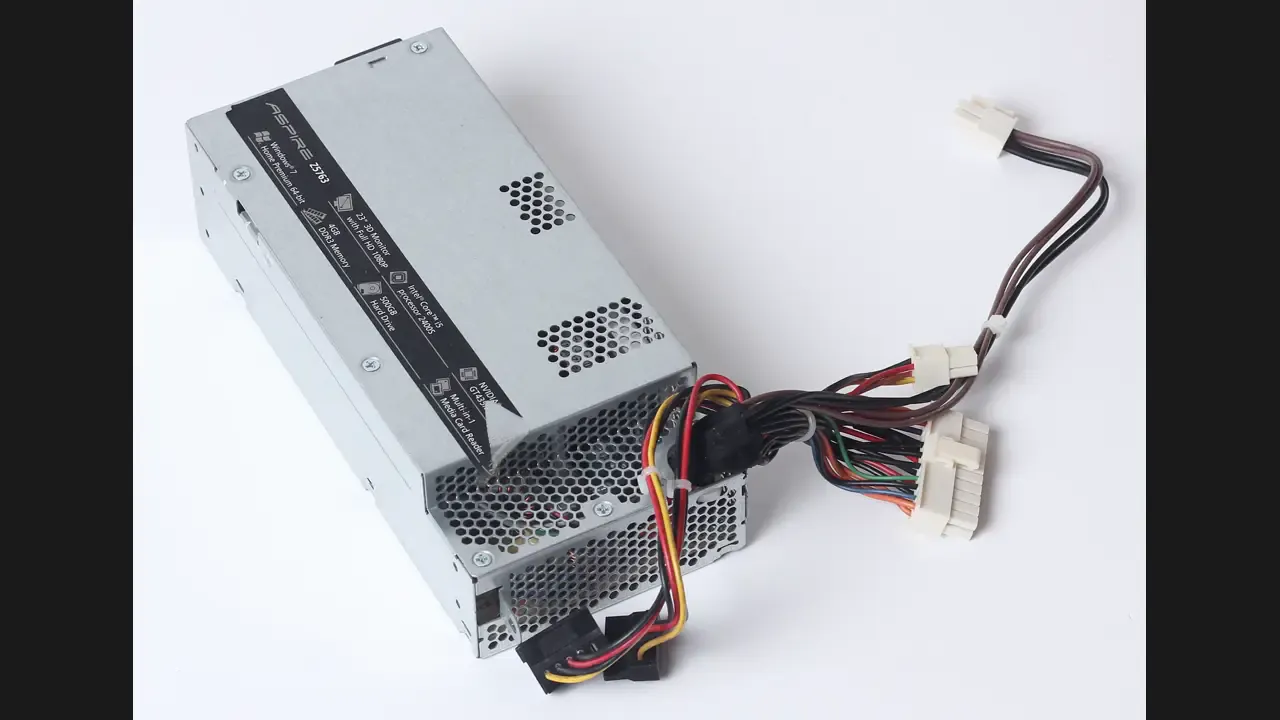
The photograph is an ATX power supply from an Acer Aspire Z5763, taken by Dmitry Makeev on 7 June 2018 and released under CC BY-SA 4.0. It is a Commons photograph of that supply. It is not one of the listings under this story, and it is not the image on any listing.
The sticker is the sustained rating. The spike the rules allow is a tenth of a millisecond. A second card left running for hours is neither of those.
The spike the sticker does not print
Treat the next sections as planning arithmetic, not as a timed test from this desk.
Intel’s ATX Version 3 Multi Rail Desktop Platform Power Supply Design Guide, document 336521, revision 2.1a, November 2023, says the document aligns to ATX Specification Version 3.1. Section 3.1 prints a card-power ratio. For an interval of 100 microseconds or less, the ratio of average power to sustained power is 3. At one second and longer, the ratio is 1. Sustained power is that one-second average. A spike three times the card’s sustained draw is allowed only inside that short window. It is not a second rating you can leave on while a model runs.
The same guide’s Table 3-3 is the supply’s side of the same idea. For a supply above 450 watts that has a 12V-2x6 connector, the excursion is 200 percent of rated size for 100 microseconds, at a 5 percent duty cycle; 180 percent for 1 millisecond, at 8 percent; 160 percent for 10 milliseconds, at 12.5 percent; 120 percent for 100 milliseconds, at 25 percent; and 100 percent with no end. Table 3-4 works the example for a 1,000 watt supply. The 100-microsecond peak is 2,000 watts, and the rest of that cycle sits at 917.7 watts, so the RMS stays at the rated wattage. The 1-millisecond peak is 1,800 watts. The 10-millisecond peak is 1,600 watts. The 100-millisecond peak is 1,200 watts. The 2,000 watt figure is a tenth of a millisecond inside a test cycle. It is not a second card you can leave running for hours.
Corsair’s own FAQ on the RM1000x page says the supply handles GPU power spikes up to 200 percent “for milliseconds.” Intel’s 200 percent window is 100 microseconds. A millisecond on the same table is 180 percent, not 200. We are not reading “milliseconds” as the 100-microsecond cell.
be quiet!’s marketing line on the Pure Power 13 M 1000W says the supply handles power excursions up to double its rated power. The specification table on that same page prints a peak power of 1,050 watts next to a continuous power of 1,000 watts. Double of 1,000 is 2,000. The table says 1,050. We are not averaging those two sentences.
MSI’s store page and Thermaltake’s Amazon about-bullet both say the supply can hold up to twice the total power excursion and three times the GPU power excursion. That is the maker’s sentence, or, on Thermaltake, the listing’s sentence. It is not a meter from this desk. Intel’s card ratio of 3 belongs to the 100-microsecond window. The supply’s 200 percent belongs to the supply’s own rating, for that same short window.
The connector that replaced 12VHPWR
Revision 2.1 of the same Intel guide, dated September 2023, says the 12VHPWR connector’s PCB header pin lengths were modified, and the connector was given a new name. The name 12VHPWR was changed throughout the document to 12V-2x6. The cable-plug side did not change, and it is compatible with the new header. A later paragraph says the 12V-2x6 connector described in PCIe CEM 5.1 replaces the 12VHPWR connector from CEM 5.0, to address reliability concerns that were observed, and that new power-supply designs should mount only the 12V-2x6. The 12VHPWR connector should be deprecated.
The mechanical change is specific. The power pins were lengthened and the sideband pins were shortened in the PCB header, so the power pins mate first and break last. The header is marked H++. The older 12VHPWR header was marked H+. The power-pin rating is 9.2 amps per pin, with a 30 °C temperature rise, with all twelve contacts energized. All twelve power pins must be 16 AWG, with no depopulation. The sideband wires are 28 AWG. The 12V-2x6 is not compatible with the older 2x3 and 2x4 auxiliary plugs. Those sit on a 4.2 mm pitch. The 12V-2x6 power pins sit on a 3.0 mm pitch. The guide recommends the 12V-2x6 on a supply above 450 watts and makes it optional at or below that.
The sideband pins are how the card learns what the cable is allowed to deliver. Table 3-6: sense pins at ground and ground mean 375 watts initial and 600 watts maximum sustained. Open and ground mean 225 and 450. Ground and open mean 150 and 300. The two sense pins shorted together mean 100 and 150. Open and open mean 0 watts. The guide says the open-open condition signals that the plug is poorly seated or absent, and that a PCIe CEM 5.1 card will read that state as the 0 watt configuration and will not attempt to draw power from the cable. An adapter, or a plug that is only halfway in, is a different electrical fact from a native cable seated until the latch clicks. The sense encodings are the supply’s job to provide to the cable. The 150 watt level can be a short in the supply or in the cable. A modular supply that uses a double-ended 12V-2x6 cable also needs a header inside the supply, so the plug can seat at that end too.
Every unit in this piece, on the maker page this desk read on 7 October 2026, ships one native cable for that job. Corsair calls it a 12V-2x6 rated 600 watts. Seasonic calls it a 12V-2×6 cable. be quiet! lists one 12V-2x6 cable, with a combined maximum of 600 watts. MSI’s connector table lists one PCI-E 5.0 16-pin, marked 600 watts, and the product text calls that connector the native 16-pin, 12V-2x6. Thermaltake’s US page lists one PCIe 12+4-pin cable marked 600 watts, and a note on the same page still says “12VHPWR cable.” We are not turning that note into a second connector. NVIDIA’s own spec tables, read the same day, still offer the other path: an adapter in the card’s box, fed by ordinary 8-pin cables. That adapter is the path the card maker printed. It is not the native cable these supplies include.
One card, and the second card the table does not define
The GPU makers print a system-power recommendation. They do not print a universal headroom number, and the cells on a single page do not always agree with each other.
NVIDIA’s GeForce RTX 5090 spec table, read on 7 October 2026, lists a total graphics power of 575 watts and a required system power of 1,000 watts. Footnote 5 says the minimum is based on a PC configured with a desktop processor NVIDIA names there, and it says to recommend a PCIe CEM 5.1 compliant supply. Power requirements can differ with the rest of the system. The supplementary-connector cell says four PCIe 8-pin cables, with an adapter in the box, or one 600 watt PCIe Gen 5 cable. A “prepare your system” block on that same page says 850 watts minimum, and it offers three PCIe 8-pin cables into the included adapter, or one 450 watt or greater PCIe Gen 5 cable. We are not averaging 1,000 and 850. We are not averaging four 8-pin cables and three. We are not averaging 600 watts and 450 watts.
The RTX 5080 spec table lists 360 watts and a required system power of 850 watts. The connector cell says three PCIe 8-pin cables, adapter in the box, or one 450 watt or greater PCIe Gen 5 cable. The same footnote 5 is on that page. A prepare block lower on that URL still names an RTX 5090 power-connector adapter. We are reading the spec table for the 5080. We are not reading that prepare block as the 5080’s connector count.
The RTX 5070 family page puts the 5070 Ti in the first column and the 5070 in the second. The 5070 Ti lists 300 watts and a required system power of 750 watts, with two PCIe 8-pin cables, adapter in the box, or a 300 watt or greater PCIe Gen 5 cable. The 5070 lists 250 watts and 650 watts, with the same connector sentence. Footnote 5 is there again.
AMD’s Radeon RX 9070 XT page lists a typical board power of 304 watts, a minimum PSU recommendation of 750 watts, and an additional power connector of two 8-pin plugs. That card does not ask for a 12V-2x6.
Intel’s Table 3-2 is a one-card budget, and it says so. A 600 watt card, with 300 watts in the CPU continuous-power column and 300 watts for the rest of the platform, is the row that lands on a 1,200 watt supply. A 450 watt card, with 300 and 250, lands on 1,000 watts. The note under the table says these budgets assume only one PCIe add-in card will use the excursions. If more than one card is installed, the system designer has to verify the supply can feed every component, including every card’s peak. The guide says it does not provide a standard definition for that kind of system.
Applied to the cards above, as arithmetic and not as a measurement: one 5090, on NVIDIA’s spec table, is a 1,000 watt system. The five 1,000 watt listings in this piece match that table, and they sit above the 850 watt line in the prepare block. They are not spare capacity past the spec table, and they are not a second card. Three times a 575 watt total graphics power, for the 100-microsecond card ratio, is 1,725 watts. That sits under the 2,000 watts a 1,000 watt ATX 3.1 supply is tested to for 100 microseconds. The 1,725 is the ratio applied to NVIDIA’s figure. It is not a wattmeter reading from this desk, and it is not a load you can hold for the length of a ComfyUI job.
One 5080, on NVIDIA’s spec table, is an 850 watt system. A 1,000 watt unit is headroom over that recommendation. It is still one card. One 5070 Ti is a 750 watt system. One RX 9070 XT is AMD’s 750 watt minimum, and it wants two 8-pin plugs, which is the 6+2 cables, not the 12V-2x6.
Two cards are the case Intel declined to define. Two boards at 575 watts are 1,150 watts of graphics power before the processor and the rest of the platform. Intel’s own one-card example for a 600 watt card is already a 1,200 watt supply. A 1,000 watt sticker does not cover that pair. And each supply this desk read ships one native 12V-2x6. Two cards that both want that plug do not both get a native cable out of these boxes.
The 6+2 count is where a second 8-pin card can still be planned, and the counts are not the same. Corsair’s FAQ lists four separate PCIe 8-pin (6+2) cables. be quiet! lists four PCIe 6+2 connectors. MSI’s table lists four PCI-E 6+2. Thermaltake’s cable table lists four 6+2 connectors on two cables, each cable 600 mm plus 150 mm. Four connectors on two daisy-chained cables are not four cables leaving the supply. Seasonic’s cable block, in the text this desk could read, was not cleanly split by wattage. The page’s FAQ says the unit includes a 12V-2×6 cable. We are not inventing a 6+2 count for that listing from a scrambled table.
Monday morning’s card guide already said the Amazon tables on those listings do not print a supply wattage, and they do not name the power plug. The figure to read is the GPU maker’s system-power line, and the plug on the card you actually have.
What the badges do not rate
CLEAResult’s 115 volt internal non-redundant table, read on 7 October 2026, sets 80 PLUS Gold at 87 percent at 20 percent load, 90 percent at 50 percent load, and 87 percent at 100 percent load, with a power factor of 0.90 at 50 percent load. Gold has no 10 percent point. Titanium is the rating on that page that adds one. The badge is those load points. It is not a noise rating. It is not the efficiency of a box sitting between jobs at a few percent of the sticker.
Cybenetics ETA is a different test. The overall efficiency is the average of more than 1,450 load combinations, spread across the range, so a maker cannot tune three points and call it done. The badge also gates power factor, 5-volt-standby efficiency, and vampire power, which is the draw with no load on the standby rail. At 115 volts, Gold is at least 87 percent and under 89 percent overall. Platinum is at least 89 and under 91. At 230 volts the same names sit higher: Gold is at least 89 and under 91, and Platinum is at least 91 and under 93. A unit can be 80 PLUS Gold and Cybenetics Platinum. Seasonic’s own FAQ says the 1,000 watt Focus GX is listed as Cybenetics Gold, the 850 watt and 750 watt versions as Cybenetics Platinum, and all three remain 80 PLUS Gold. That is the maker telling you the two badges are not one badge.
Cybenetics LAMBDA is the noise badge. A++ is under 15 dBA. A+ is at least 15 and under 20. A is at least 20 and under 25. A- is at least 25 and under 30. 80 PLUS does not say any of that.
be quiet!’s “up to 94.4 percent” is one cell: efficiency at 230 volts and 50 percent load. The cell next to it, at 2 percent load, is 72.6 percent. The maker’s Cybenetics ETA cell on that page is a dash. The Amazon title says Cybenetics Platinum. We are not filling the dash from the title. A Cybenetics report for that part, lab ID BQ10002834, prints an average efficiency of 90.551 percent on one input and 92.564 percent on the other, each across more than 1,450 load combinations. The badge word was not in the text this desk could read. We are not promoting the title’s “Platinum” over the dash, and we are not promoting the dash over the title.
A box waiting between prompts is closer to the light-load row than to the 50 percent cell. At Gold’s 100 percent point of 87 percent, 1,000 watts of DC output is about 1,149 watts at the wall. That division is the badge applied to the sticker. It is not a measurement of these five units. It is the number Monday’s UPS has to be sized against, because the UPS watt ceiling is a wall figure. The supply’s sticker is the DC rating.
The cables you do not install
All five maker pages call the cabling fully modular. Corsair’s tech table says Modular: Fully, cable type Type 4. Seasonic says fully modular, individual black cables with a braided pattern. be quiet! marks modular cables, sleeved and flat. MSI says a fully modular design and flat black cables. Thermaltake’s US page says fully modular flat black cables. You install the 24-pin, the EPS leads the board actually uses, the one 12V-2x6 if the card has that socket, and the 6+2 leads the other card wants. The rest stay in the bag. Unused leads in the case are an airflow problem, and airflow is the overnight noise path. Intel’s note on a modular 12V-2x6 is the header inside the supply, so the double-ended cable seats at both ends. A cable from a different brand’s modular system is not that header. Corsair’s FAQ says Type 4 cables from other Corsair families interchange, and it says never to mix cables from different brands.
The fan that stops, and the job that does not
Zero RPM is a load band, not a personality.
Corsair’s product section says Zero RPM mode eliminates fan noise at low to medium loads. A use-case sentence on the same page says the 140 mm fan stops at loads below 40 percent. Forty percent of 1,000 watts is 400 watts. A 575 watt graphics card is already over that line before the processor is counted. The Cybenetics report for CP-9020271, read the same day, marks semi-passive operation as selectable, and the note on the unit tested says semi-passive off. Average noise is 24.78 dBA on one input and 24.81 dBA on the other. That average sits inside the A band, which is at least 20 and under 25. At 100 percent load the same report prints 35.5 dBA, with the fan at 1,113 rpm. Corsair’s FAQ glosses the A rating as under 30 dBA. Under 30 is the top of A-, not the top of A. The tech table says Noise: A. The 100 percent row is neither the FAQ’s sentence nor the zero-RPM band.
Seasonic’s 1,000 watt table lists Cybenetics noise level A-. The fan is a 135 mm fluid-dynamic bearing, on the three-stage control the page calls fanless, silent, and cooling. The FAQ says the fan can stop completely when cooling demand is low.
be quiet! says the fan turns off completely under low load. The noise cells are 8.2 dBA at 10 percent, 8.2 at 20 percent, 8.6 at 50 percent, and 19.5 at 100 percent. The fan is 120 mm, rifle bearing, 2,000 rpm maximum. The Cybenetics LAMBDA cell on the maker page is a dash. The lab report’s average noise is 10.65 dBA and 10.58 dBA. We are not assigning an A++ badge the report text did not print.
MSI’s page for the MAG A1000GL describes a 135 mm fluid-dynamic bearing fan. It does not say the fan stops. Thermaltake’s US page for the 2025 version describes a 13.5 cm fluid-bearing fan. It does not say the fan stops.
A llama or ComfyUI job that runs for hours is the load. It is not the band where the fan is allowed to stop. Zero RPM is the hours the box is on and the model is not.
Ten years is a bet, not a test
A warranty length is the maker’s bet that the capacitors outlast the graphics card you will replace. It is not a life test from this desk.
Corsair’s tech table says Warranty: 10 Year, and the Amazon warranty cell says 10 Year Manufacturer. Seasonic’s specification table says 10 Years, and the Amazon cell says 10 Year Manufacturer. be quiet!’s service table says 10 years, and the Amazon title says 10 Year Warranty. The Amazon product-info table this desk read for that listing did not include a warranty-description cell. MSI’s store lists a manufacturer warranty of 10 years, a separate line says power supplies are warranted for 120 months, and the Amazon cell says 10 Year Limited Manufacturer. Thermaltake’s Amazon cell says 10 Year Manufacturer. The US maker specification table this desk read, for part PS-TPD-1000FNFAGU-4, did not print a warranty year. We are not inventing one from the Amazon cell, and we are not dropping the Amazon cell because the maker table was silent.
The wall, and Monday’s UPS
The supply and the UPS are doing different jobs. The supply is what has to absorb the 100-microsecond spike and then hold the sustained draw for the length of the job. The UPS is what has to hold the wall watts when the outlet sags. Monday afternoon’s guide is that watt ceiling: the VA figure, the watt figure, the waveform, and the runtime. This guide does not restate it.
What this guide adds is the conversion. The sticker is DC output. The outlet sees AC input. At the Gold 100 percent point, that input is higher than the sticker by the efficiency the badge allows you to assume, which is the 1,149 watt arithmetic above. A UPS whose watt rating sits under the wall draw of a supply that is actually delivering a 1,000 watt sticker will not hold the job, no matter how long the battery claims to last. Size the UPS from the wall figure. Size the supply from the GPU maker’s system-power line, the plug the card has, and the excursion window you are not going to spend as a second card.
What the five supplies are
Other ATX supplies exist. Some are still on the 12VHPWR name. Some are SFX, which is a different mounting hole pattern, and this guide is not that box. Four of the five below are the listings we can attach to a real Amazon Associates tag, threadandfade-20, with a photograph Amazon actually served for that ASIN. The fifth, the be quiet! Pure Power 13 M 1000W, is a real listing this desk opened. The image URL for its ASIN returned a one-pixel placeholder, not a photograph of the unit. A card needs a photograph. That listing stays in prose. We are not ranking any of them against each other, or against any supply we cannot link.
One supply is the CORSAIR RM1000x ATX 3.1 PCIe 5.1 1000W Power Supply – Black. The short name is the Corsair RM1000x. The Amazon title joins that sentence to a differentiator that names a native 12V-2x6, fully modular cabling, low noise, and Cybenetics Gold. The model name on Amazon is RMx. The model number and the manufacturer part number say CP-9020271-NA. The UPC cell says 840006667698. Corsair’s power table prints a third pair of numbers, model RPS0198 and part 75-005877. We are carding the title and CP-9020271-NA. We are not picking RPS0198 over the Amazon part.
The power table says 100 to 240 volts, input current 12 A to 5 A, 47 to 63 Hz, +3.3 V at 20 A and +5 V at 20 A combined to 150 watts, +12 V at 83.3 A and 1,000 watts, +5 V standby at 3 A and 15 watts, total 1,000 watts. A Cybenetics report for the same part prints the manufacturer-provided rated current as 12 A to 6 A. Amazon’s current-rating cell says 25 A. We are not averaging 5, 6, and 25. Amazon’s dimension cell says 2.3 by 3.39 by 5.91 inches. Corsair’s tech table says 160 by 150 by 86 mm, and the weight cell says 3 kg. Amazon’s weight cell says 6.9 pounds. We are not treating the Amazon box as the tech-table box. Amazon’s compatible-devices cell says Monitor. The page is a desktop supply.
The FAQ cable list is one 24-pin at 610 mm, two EPS 8-pin (4+4) at 750 mm, one 12V-2x6 at 650 mm rated 600 watts, four PCIe 8-pin (6+2) at 650 mm, three SATA cables with four connectors each at 850 mm, and two PATA cables with three connectors each at 750 mm. The tech table’s connector counts agree: one ATX, SATA 12, PATA 6. The Cybenetics cable table, measured on the unit the lab received, lists the 12-plus-2-pin PCIe cable at 600 mm, marked 600 watts, and lists SATA lengths of 500 mm plus three 115 mm hops. The connector counts agree. The lengths do not. We are not averaging 650 and 600, or 850 and 500.
Amazon’s about line says Cybenetics Gold, up to 91 percent. The Cybenetics report prints an average efficiency of 89.047 percent on one input and 91.139 percent on the other. A documentation blurb on Corsair’s page calls the unit an RMx 80 PLUS Gold supply. The tech table’s efficiency cell says Cybenetics Gold, not 80 PLUS. We are not collapsing “up to 91 percent” into either average, and we are not upgrading the documentation blurb into the tech table. When this desk opened the listing on 7 October 2026, the page showed In Stock, an offer that ships from and is sold by Amazon.com, with free delivery Monday, October 12, and a resale offer sold by Amazon Resale with a quantity line that said only 1 left. Those lines are inventory. They will move. They are not a spec.
The second supply is the Seasonic Focus GX-1000 1000W Power Supply ATX 3.1 & PCIe 5.1 Ready. The short name is the Seasonic Focus GX-1000. The Amazon title’s differentiator says 80 Plus and Cybenetics Gold, fully modular, a 12V-2x6, and a 10 year warranty. The model name, the model number, and the manufacturer part number all say Focus GX-1000 ATX 3.1. There is no SSR-style code in those cells. The UPC cell says 882016002748. A white variant is a different ASIN. The title on this listing does not say White. A customer review described a white unit. That is a review. We are not promoting it to a color.
The 1,000 watt table says 80 PLUS Gold, with the series line “90 percent efficiency at 50 percent system load,” Cybenetics efficiency Gold, and Cybenetics noise A-. The 850 watt and 750 watt tables on the same page say Cybenetics Platinum and stay 80 PLUS Gold. The FAQ says that split out loud. The fan is 135 mm, fluid dynamic bearing. Amazon’s fan-size cell says 14 centimeters. Dimensions are 140 by 150 by 86 mm, which is the same three magnitudes as Amazon’s 5.5 by 5.9 by 3.4 inches. Amazon’s weight cell says 3.5 pounds. The maker table this desk read did not print a weight. AC input on the 1,000 watt table is 100 to 240 volts, 13 to 6.5 A, 50 to 60 Hz. Amazon’s input cells say 90 volts minimum and 132 volts maximum. We are not averaging 90 and 100, or 132 and 240. DC output is +3.3 V at 25 A and +5 V at 25 A, combined 125 watts, +12 V at 83 A and 996 watts, −12 V at 0.3 A and 3.6 watts, +5 V standby at 3 A and 15 watts, total continuous 1,000 watts. Protections are OCP, OPP, OTP, OVP, SCP, and UVP. MTBF is 100,000 hours at 25 °C, excluding the fan. Warranty is 10 years.
The installation note says both ends of the 12V-2×6 cable have to be fully inserted, click-locked, and tight, and that you do not bend the cable after it is plugged in. That is the seating rule Intel’s open-open cell is about. When this desk opened the listing on 7 October 2026, the offer this desk could read carried a free-delivery window of October 30 to December 2. That line is inventory. It is not a spec.
The third supply is in prose only. It is the be quiet! Pure Power 13 M 1000W. The Amazon title says 80+ Gold and Cybenetics Platinum, and the differentiator says PCIe 5.1, ATX 3.1, fully modular, an LLC topology, a semi-passive fan, a single rail, and a 10 year warranty. The model name, the model number, and the manufacturer part number say BP028US. The ASIN is B0FBXX1D17. The article number on the maker page is BP028US, and the EAN is 4260052192252. There is no shop card under this story for that ASIN.
The maker table says continuous power 1,000 watts and peak power 1,050 watts, against the marketing line that says excursions up to double the rated power. Form factor ATX 3.1, EPS 12V version 2.92, topology LLC plus synchronous rectification plus DC-to-DC. Input 100 to 240 volts, 50 to 60 Hz, 12 A and 6 A. 80 PLUS Gold. Cybenetics ETA is a dash. Cybenetics LAMBDA is a dash. The 230 volt efficiency row is 72.6 percent at 2 percent load, 91.2 at 10, 93.9 at 20, 94.4 at 50, and 92.5 at 100. One 12-volt rail, 83.4 A, combined 12-volt power 1,000 watts, combined 12V-2x6 power 600 watts, combined 3.3-plus-5-volt power 120 watts at 22 A each. Hold-up is 21.09 ms at 100 percent load and 28.62 ms at 80 percent. Cables: eight, one motherboard, one P4+4, one P8, one 12V-2x6, four PCIe 6+2, six SATA, two PATA. Dimensions 160 by 150 by 86 mm. Weight 2.64 kg. Amazon’s weight cell says 3.14 kg, and Amazon’s dimension cell says 6.3 by 5.91 by 3.39 inches. We are not averaging 2.64 and 3.14. Color black. Warranty on the maker table is 10 years. When this desk opened the listing on 7 October 2026, the offer this desk could read was a used, like-new unit sold by Computer Headquarters, Inc, with delivery Thursday, October 15. That line is inventory. We are not inventing a new offer the page did not show.
The fourth supply is the msi MAG A1000GL PCIE5. The short name is the MAG A1000GL. The Amazon title says fully modular, 80+ Gold, ATX 3.1 and PCIe 5.1, a native dual-color 12V-2x6 cable, and a 10 year warranty. The style selector says MAG A1000GL PCIE5. The model-number cell and the manufacturer part number say MAGA1000GLPCIE5. The model-name cell says MPG A750GF. That is a different supply. We are carding the title and MAGA1000GLPCIE5. We are not carding the A750GF cell. The UPC cell says 824142339763.
MSI’s store table says 1,000 watts, 80 PLUS Gold up to 90 percent, input 100 to 240 volts, 10.0 A maximum at 115 volts and 5.0 A maximum at 230 volts, 50 to 60 Hz, a 135 mm fluid-dynamic bearing fan, and protections OCP, OVP, OPP, OTP, SCP, and UVP. The connector table is one 24-pin, two EPS 4+4, one PCI-E 5.0 16-pin at 600 watts, four PCI-E 6+2, twelve SATA, four Molex, and one FDD. Dimensions 150 by 150 by 86 mm. Weight 7.60 pounds. Amazon’s dimension cell says 11.5 by 9.25 by 5 inches. Amazon’s weight cell says 7.3 pounds. We are not averaging those. Amazon’s compatible-devices cell says NVIDIA GeForce RTX 30 series GPUs and AMD GPUs. The store page says the unit supports the GeForce RTX 50 series. We are not picking one generation and deleting the other. The product text says up to twice the total excursion and three times the GPU excursion, and it says the native 16-pin connector has yellow on it so a loose plug is visible. Other supplies on that same store page advertise two 12V-2x6 connectors. This table lists one. The topology line on the page is spelled “Full Bridege LCC.” We are not correcting the spelling into a different circuit. When this desk opened the listing on 7 October 2026, the offer this desk could read carried a free-delivery window of October 27 to November 3. That line is inventory. It is not a spec.
The fifth supply is the Thermaltake Toughpower GF3 1000W, part PS-TPD-1000FNFAGU-4. The short name is the Toughpower GF3 1000W. The Amazon title says ATX 3.1, a native PCIe 5.1 12V-2x6, flat cables, color-matched connectors, Japanese main capacitors, a 135 mm fan, and 80 Plus Gold. The model name is Toughpower GF3. The model number and the manufacturer part number say PS-TPD-1000FNFAGU-4. The UPC cell says 841163084090. The maker’s specification table prints a second model string, TPD-1000AH3FCG. We are carding the title and PS-TPD-1000FNFAGU-4. A different suffix, on a UK page, is an older ATX 3.0 unit. We are not merging that page into this part.
An about-bullet says the supply is built to ATX 3.1 and then names “the Toughpower GT 1000W.” GT is a different line. The title and the part number say GF3. We are carding GF3. The same bullet says up to three times GPU power excursion and up to twice total power excursion. The US maker page says the unit is built to meet Intel ATX 3.1 and has a native 12+4-pin PCIe Gen 5.1 connector. Note 2 on that page says to follow the GPU maker’s power requirements before using the 12VHPWR cable. The connector table says one 12+4-pin at 600 watts. We are reading one cable under two names on the maker’s own page.
The DC table says +3.3 V at 20 A and +5 V at 20 A, combined 110 watts, +12 V at 83.3 A and 999.6 watts, −12 V at 0.3 A and 3.6 watts, +5 V standby at 3.0 A and 15 watts, total 1,000 watts. An AC line above that table says 100 to 240 volts, 15.0 A maximum, 47 to 63 Hz. The specification table says input current 13.0 A and 6.5 A, 50/60 Hz. Amazon’s current-rating cell says 10 A. We are not averaging 15, 13, and 10. Hold-up is greater than 17 ms at 100 percent load. Dimensions are 150 by 86 by 160 mm. Amazon’s dimension cell is 6.3 by 5.9 by 3.4 inches, the same three magnitudes in a different order. Weight on the maker table is 1.72 kg. Amazon says 4 pounds. Efficiency marketing says up to 90 percent. The specification cell says “Meet 80 PLUS Gold at 115Vac input.” We are not turning 90 percent into the Gold point of 87 percent at full load, and we are not turning the Gold point into 90.
The cable table is one 24-pin at 550 mm, two ATX 12 V 4+4 cables at 700 mm, four PCIe 6+2 connectors on two cables at 600 mm plus 150 mm, one PCIe 12+4-pin at 600 mm, six SATA connectors on two cables, and four peripheral connectors on one cable. The SATA row is labeled “SATA (5Pin).” A SATA power plug is not a 5-pin part. We are not correcting the label into 15 pins, and we are not treating the label as a connector this desk has counted. A user-manual file linked from the page titled 2025 Version carries the date 2022-07-17. The page title and the file date are both on the page. We are not picking one. The Amazon warranty cell says 10 Year Manufacturer. The maker specification table did not print a year. When this desk opened the listing on 7 October 2026, the page showed In Stock, an offer that ships from and is sold by Amazon.com, and a resale offer sold by Amazon Resale with a quantity line that said only 1 left. Those lines are inventory. They are not a spec. The maker’s own store, opened the same day, showed the 2025 version sold out.
Which listing to read for which limit
Choose the Corsair RM1000x when you want one native 12V-2x6, four separate 6+2 cables, and you have already read the 40 percent zero-RPM sentence against the card you mean to run for hours. The part to match is CP-9020271-NA. The power-table current is 12 A to 5 A. The Cybenetics manufacturer line is 12 A to 6 A. Amazon says 25 A. The FAQ’s “milliseconds” is not Intel’s 100 microseconds. The noise cell is A. The FAQ’s “under 30 dBA” is a looser sentence than that band.
Choose the Seasonic Focus GX-1000 when the 1,000 watt table’s Cybenetics Gold is the badge you mean, and you are not buying it because the 850 watt row on the same page says Platinum. The part to match is the model string Focus GX-1000 ATX 3.1. The title does not say White. The cable block was not clean enough, in the text this desk read, to quote a 6+2 count. The seating note on the 12V-2×6 is the sentence to follow.
Choose the be quiet! Pure Power 13 M 1000W when you have read the peak-power cell of 1,050 watts next to the sentence that says double, and the 72.6 percent cell at 2 percent load next to the 94.4 percent cell at 50 percent. The part to match is BP028US. The ETA cell is a dash. The Amazon title says Cybenetics Platinum. There is no shop card, because the image URL did not return a photograph.
Choose the MAG A1000GL when the part in your cart is MAGA1000GLPCIE5 and the model-name cell that says MPG A750GF has not talked you into a different unit. The store page supports the RTX 50 series. The Amazon compatible-devices cell says RTX 30 series. The connector table lists one 16-pin, not two. The page does not say the fan stops.
Choose the Toughpower GF3 1000W when the part is PS-TPD-1000FNFAGU-4 and the about-bullet that says Toughpower GT has not talked you into the other line. Four 6+2 connectors live on two daisy-chained cables. The maker page uses 12+4-pin and the word 12VHPWR for the same native lead. The Amazon warranty cell says 10 years. The maker specification table this desk read did not.
A sticker we did not measure is the wrong reason to choose. A review on the page that liked a quiet fan is the wrong reason too. The supplies are the listings. Artificial Examiner has not opened these boxes, has not installed them, has not run llama.cpp, Ollama, LM Studio, or ComfyUI on them, and has not metered a rail. The blurbs under the story say that in shorter form.
The buttons under the article go to four Amazon listings with our Associates tag, threadandfade-20. They are advertisements. The commission, if a purchase happens, does not size the spike. The sustained wattage the job has to draw does.
This story includes affiliate links. If you buy through them, Artificial Examiner may earn a commission. That does not change the reporting. See our affiliate disclosure.