The microphone a local transcript hears is not the model a size chart picks
A buyer guide to USB microphones for whisper.cpp, faster-whisper, and a local voice note. The shop cards are a Shure MV7+, a RØDE PodMic USB, a Samson Q2U, an Audio-Technica AT2020USB-X, and a Blue Yeti Blackout. The capsule and the gain are the ceiling. Artificial Examiner has not bench-tested these microphones. The links are affiliate.
TORONTO — October 6, 2026
A size chart ranks the model. A local transcript ranks the samples that survived the room. A larger Whisper file does not add a cardioid lobe. It does not move a gain knob. It does not unclip a plosive that already flattened the take.
This morning’s guide was the processor the leftover layers fall back on. That chip is a memory bus and an instruction set, not a capsule. Yesterday afternoon’s guide was the power that has to stay up while the job runs. That UPS is a watt ceiling, not a microphone. Yesterday morning’s guide was the card. That 16 GB card is the pool the weights want first. Sunday afternoon’s guide was the box without a slot. That mini PC already has a processor soldered down. The file still sits on a drive until a loader maps it, which was Saturday’s disk guide. The working set on a machine with no discrete card is still system RAM, which was Saturday’s memory guide. The pane you watch the log on is still Sunday morning’s monitor. None of those seven is the thing in front of your mouth.
The microphones under this story are affiliate links. If you buy through them, Artificial Examiner may earn a commission. Artificial Examiner has not bench-tested these microphones. There is no word-error figure in this piece, because this desk did not transcribe a file on any of them. There is no price in this piece.
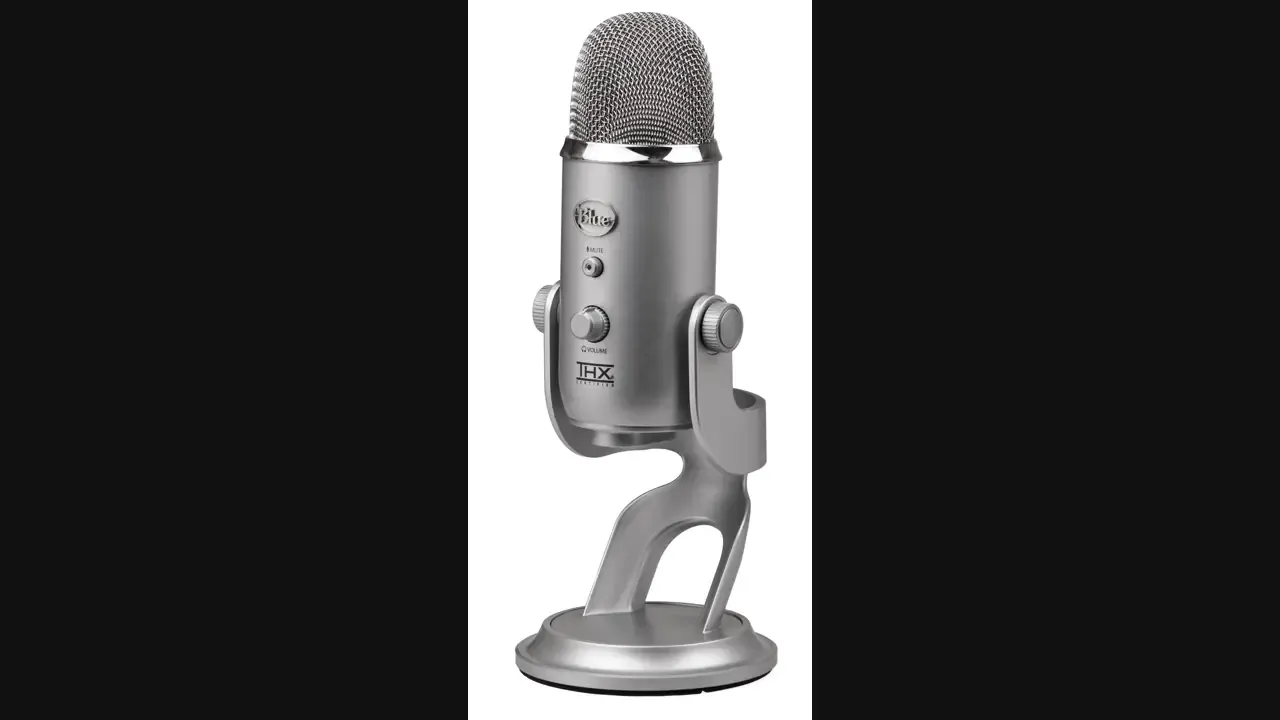
The photograph is a Blue Yeti USB microphone, taken by Evan-Amos on 12 August 2011 and released into the public domain. It is a Commons photograph of that microphone. It is not the Blackout color on the Amazon listing, and it is not the image on the listing.
The chart wants a larger model. The transcript wants a capsule pointed at a mouth, a gain that is not clipping, and a pattern willing to ignore the room.
What the model actually ingests
Treat the next sections as planning arithmetic, not as a timed test from this desk.
OpenAI’s Whisper loader, as this desk read it on 6 October 2026, sets SAMPLE_RATE to 16000. load_audio asks ffmpeg for one channel of 16-bit little-endian PCM at that rate, and the comment on the log-mel function says the waveform is in 16 kHz. faster-whisper’s decoder, read the same day, defaults decode_audio to a sample rate of 16000 and resamples to mono 16-bit before it converts the samples to float. The file’s own note points back at the Whisper loader. whisper.cpp’s README, read the same day, says the whisper-cli example currently runs only with 16-bit WAV files, and the ffmpeg line it prints is -ar 16000 -ac 1 -c:a pcm_s16le.
A microphone that advertises 96 kHz does not hand the model 96,000 samples a second. The loader throws the extra samples away on the way to 16 kHz. A 24-bit converter does not survive a request for pcm_s16le. What is left is whatever the capsule, the pattern, the gain, and the room put into the band that still exists after that resample. A clipped plosive is in that band. A fan inside an omnidirectional lobe is in that band. A larger ggml file reads the same samples.
This desk did not measure a word-error rate on any of these microphones, and it did not time a model. A model card can still be right that a larger model misses fewer words on a clean file. It does not rewind a take that was already ruined. The transcript is also the prompt, if the next step is a local model. A wrong word in the transcript is a wrong word in the prompt. The microphone sits upstream of this morning’s processor.
Cardioid, and the patterns that hear the room
Cardioid hears what is in front and rejects what is behind. Omnidirectional hears the room. Bidirectional hears the front and the back and rejects the sides. Stereo is two channels. The loaders above down-mix to one channel. A stereo pattern does not arrive as a stereo picture.
A Blackout user-manual page this desk read on 6 October 2026, the technical-specifications page of the Blue Yeti USB Microphone (Blackout) manual, prints four patterns: cardioid, bidirectional, omnidirectional, and stereo. The same page says omnidirectional picks up sound equally from all around the mic, and it names a multi-person podcast and a conference call as the use. It says cardioid records a source directly in front. It says bidirectional records the front and the rear, for a duet or a two-person interview. Dictation into a local model is the cardioid case: one mouth, close. An interview across a table is the bidirectional case, or two cardioid microphones this guide is not selling. Omnidirectional in an untreated room is the case where the model is asked to transcribe the HVAC along with the sentence.
Amazon’s about-this-item lines on the Blackout listing name the same four patterns: cardioid, omni, bidirectional, and stereo. The spec table’s polar-pattern cell says Multipattern. We are reading those as one switch, not as four microphones.
When a dynamic beats a condenser
Audio-Technica’s page for the AT2020USB-X prints the distinction in its own words. A condenser, on that page, is extremely sensitive and picks up the subtlest sounds in any environment. A dynamic, on the same page, minimizes room noise. That is the maker’s sentence. It is not a word-error test from this desk.
Three of the listings below are dynamic and cardioid: the Shure MV7+, the RØDE PodMic USB, and the Samson Q2U. Two are condensers: the AT2020USB-X, which is cardioid only, and the Blue Yeti Blackout, which can be switched off cardioid. A dynamic cardioid is the untreated-room tool, because the capsule is already less willing to hear the room and the pattern is already pointed at the mouth. A condenser cardioid is still a condenser. The AT page says it is the sensitive one. Point it closer, turn the gain down, and put something between the mouth and the grille if the box did not include a pop filter. The Yeti on omnidirectional is the sensitive capsule asked to hear the whole room. That is a choice the pattern switch makes. It is not a choice a model size makes.
Gain, plosives, and the headphone jack
The headphone jack is how you hear the clip while the take is happening, instead of discovering it in a transcript. Every listing below prints a monitor path.
Shure’s MV7+ user guide calls the 3.5 mm output latency-free monitoring, and it lists an adjustable gain range of 0 to +36 dB. The USB-C maximum SPL on the same page is 128 dB SPL, and the footnote says that figure is at minimum gain, flat mode. The 128 is not the ceiling after the gain has been turned up. This desk is not inventing the ceiling at +36 dB. The on-board DSP line names Auto-Level Mode, a Digital Popper Stopper, and a Real-time Denoiser. Those are processing on the way out of the microphone. They are not a larger model.
RØDE’s PodMic USB datasheet lists a 3.5 mm headphone jack among the analogue output connectors. The product page says the headphone output is zero-latency monitoring with a level control. The same page, and the datasheet, name an internal pop filter and a professional pop filter in the box. A pop filter is a physical answer to the puff on a p or a b. The puff clips the same way a shout clips. The model never sees the puff. It sees the flat samples.
Samson’s Q2U page lists a 1/8 inch stereo headphone output with level control, and it calls the monitoring zero-latency. The included-accessories line includes a foam windscreen. The feature list says the windscreen is there to minimize wind noise and plosives.
Audio-Technica’s specification table lists a 3.5 mm stereo headphone jack, a headphone level control, a mix control, and mute. The mix control, on the same page, blends the microphone with audio from the computer. The included-accessories line is a desk stand, a thread adapter, and a USB-C cable. A pop filter is not in that line. The optional-accessories paragraph names a shock mount, the AT8455. A shock mount is not a pop filter.
Logitech’s Yeti page, on the Blackout color, says you monitor through the headphone output, latency-free, and that a gain control on the microphone sets the sensitivity. Amazon’s about line adds pattern selection, instant mute, and mic gain. The same Logitech page says Blue VO!CE, including a Depopper, requires the G HUB download. A depopper in an app is software. It is not a foam windscreen in the box. Amazon’s what’s-in-the-box line is the microphone, instructions, and a USB cable.
If the meter is pinned, the samples are already flat. Stepping the model from a small ggml file to a large one does not unflatten them.
The connector, and the operating systems the pages name
USB Audio Class is the reason a vendor driver is the wrong thing to hunt for before you have read the compatibility line. Shure’s specifications print the power requirement as USB Audio Class 2, UAC2, powered through the USB-C bus, USB 2.0 or higher. The same guide’s compatibility sentence names Windows, Mac, iOS, and Android. It does not name Linux. The system lines are Windows 10 and higher, macOS 12 and higher, iOS 16 and higher, and Android 12 and higher. A note says the microphone is not compatible with Xbox. A Linux machine whose audio stack already speaks UAC2 may still enumerate the device. This desk did not plug the MV7+ into Linux, and this desk is not turning Shure’s compatibility sentence into a Linux promise.
Samson’s feature line says plug-and-play, no driver installation required. The USB-output line names Mac, PC, or Chromebook. Linux is not in that sentence.
RØDE’s datasheet prints a minimum OS line of Windows 10 and Mac OS 10.15. The product page adds iOS and Android, and it says plug-and-play. Linux is not in either sentence.
Audio-Technica’s system-requirements cell is Windows 8.1, Windows 10, Windows 11, macOS Catalina, Big Sur, and Monterey, and it says USB 2.0 compliant. Linux is not in that cell. USB 2.0 compliant is not the same words as UAC2. This desk is not upgrading one into the other.
Logitech’s Yeti page says no drivers required, and it says to plug the included USB cable into a computer. Amazon’s about line says Mac or PC. The Blackout manual’s system block names Windows and macOS, and USB 1.1, 2.0, and 3.0, and it says to plug directly into the computer and avoid a hub. Linux is not in that block. The same Logitech page says G HUB is required for Blue VO!CE. Amazon’s product description says G HUB is required for full functionality. Those are two sentences. Basic plug-and-play is the “no drivers” sentence. The effects software is the download. This desk is not folding them into one.
USB-C is a separate fact from class compliance. The MV7+, the PodMic USB, and the AT2020USB-X print USB-C on the maker page. The Q2U’s maker table prints USB-C, and the Amazon product-description snapshot on that listing prints USB (mini). The Yeti’s Amazon connector cell says USB. The manual page this desk read does not print a connector shape. A customer review on the Amazon page called the port mini-USB. That is a review. It is not a spec cell. This desk is not promoting it to one.
What the five microphones are
Other USB microphones exist. Some are headsets. Some are XLR-only, which is a different cable and a different box, and this guide is not that box. These five are only the listings we can attach to a real Amazon Associates tag, threadandfade-20. We are not ranking them against each other or against any microphone we cannot link.
One microphone is the Shure MV7+ USB-C & XLR Podcast Dynamic Microphone - Black. The short name is the Shure MV7+. The Amazon title is that sentence. The model name, the model number, and the manufacturer part number all say MV7+-K. The UPC cell says 042406791571. The about lines say a USB-C and XLR output, an auto-level mode, a real-time denoiser, and a foam windscreen with a 3 m USB-C to USB-C cable in the box. Shure’s guide agrees on the dynamic capsule, the cardioid pattern, the USB-C and XLR connectors, the foam windscreen’s job as a windscreen, and the one included cable, which is USB-C to USB-C. An XLR cable is not in that line. The guide’s frequency response is 50 Hz to 16,000 Hz. Amazon’s frequency-range cell says 50 Hz to 16 kHz. Those match. Amazon’s polar-pattern cell says Unidirectional. The comparison chart on the same listing says Cardioid. Shure says Unidirectional (Cardioid). We are reading one pattern under two labels.
The bit-depth lines inside Shure’s own guide do not sit in one sentence. The A/D converter line says 16 or 24-bit, 48 kHz, with an asterisk on the 16. The bit-depth table says 24-bit at 48 kHz, and 16-bit at 44.1 kHz, and the asterisk is glossed as iOS only. We are not averaging 48 and 44.1, and we are not dropping the asterisk. USB-C sensitivity on the guide is −33 dBV/Pa at 1 kHz. XLR sensitivity is −55 dBV/Pa. Amazon’s audio-sensitivity cell says 40 db. We are not treating 40 as either of Shure’s figures. Amazon’s form-factor cell says Handheld. The guide describes an adjustable yoke on a 5/8-inch thread. We are carding the title and MV7+-K. We are not carding a handheld. When this desk opened the listing on 6 October 2026, the page showed In Stock. A line said it ships from and is sold by Amazon. A merchant block named Electronics Expo, an authorized dealer. Another line said a lower price was available from other sellers. A quantity line this desk could read said only 8 left. Those lines are inventory. They will move. They are not a spec.
The second microphone is the RØDE PodMic USB Dynamic Broadcast Microphone, XLR + USB-C. The short name is the RØDE PodMic USB. The model name on Amazon is PodMic USB. The model number and the manufacturer part number say PODMICUSB. The UPC cell says 698813010707. The about lines say XLR and USB-C, onboard processing, a dynamic capsule that rejects room noise, a headphone jack, and a box that includes the microphone, a swing mount, a USB-C cable, and a pouch. The what’s-in-the-box line says the PodMic USB, a pop filter, and an SC29 3 m USB-C to USB-C cable. RØDE’s datasheet agrees: dynamic, cardioid, end address, 20 Hz to 20 kHz, USB-C, 24-bit, 48 kHz, a 3.5 mm headphone jack, and a 3-pin XLR. Maximum SPL is 148 dB SPL. Digital equivalent noise is 19 dBA. The minimum OS line is Windows 10 and Mac OS 10.15. Amazon’s frequency-range cell says 20 Hz to 20 kHz, which matches the datasheet. Amazon’s polar-pattern cell says Unidirectional. We are reading that as the datasheet’s cardioid, not as a second pattern. Amazon’s signal-to-noise cell says 60 db, and an audible-noise cell says 94 db. The datasheet’s noise figure is 19 dBA digital and 26 dBA analogue. We are not averaging 60, 94, and 19. The sample rate is on the datasheet. It is not a row in the Amazon spec table this desk read. When this desk opened the listing on 6 October 2026, the page showed an offer that ships from and is sold by Amazon.com, and another offer, described as a returned unit, that ships from and is sold by Sole Source AV Supply, with a quantity line that said only 1 left. Those lines are inventory. They are not a spec.
The third microphone is the SAMSON Q2U USB/XLR Dynamic Microphone Recording and Podcasting Pack (Black). The short name is the Samson Q2U. The model name is Q2U. The model number and the manufacturer part number say SAQ2U. The UPC cell says 809164022336. The about lines say USB or XLR, a 3.5 mm headphone output, a cardioid pattern, and a box with a clip, a desktop tripod, a windscreen, an XLR cable, and a USB cable. The description snapshot on the same listing says the element is dynamic cardioid, the frequency response is 50 Hz to 15 kHz, and the outputs are USB (mini), XLR, and a 3.5 mm headphone. Samson’s specification table says dynamic, cardioid, 50 Hz to 15 kHz, sensitivity −54 dBV/Pa, maximum SPL 148 dB SPL, bit depth up to 16-bit, sample rate 44.1 kHz or 48 kHz, digital output USB-C, analog output XLR, and a 1/8 inch headphone jack. A comparison table on that same Samson page prints the Q2U frequency response as 20 Hz to 18 kHz. The two cells do not match. Amazon’s snapshot matches the 50 Hz to 15 kHz cell. We are not averaging 15 kHz and 18 kHz, and we are not picking the comparison table over the specification table. The connector cells do not match either. Samson says USB-C. Amazon’s snapshot says USB (mini). Amazon’s connector-type cell says XLR, while the connectivity cell says USB. The title does not say which plug is on the digital jack. We are carding the title and SAQ2U. If the microphone that arrives has a mini-USB jack, that is the snapshot’s line. If it has USB-C, that is the maker table’s line. Look at the jack. Amazon’s battery cell says one lithium-ion battery is required. Samson’s page does not list a battery. A dynamic capsule on XLR does not need a cell to be dynamic, and the USB side, on Samson’s page, is bus-powered. We are not carding a battery. When this desk opened the listing on 6 October 2026, the page showed In Stock, an offer sold by FocusProAudio, and a quantity line that said only 1 left. Those lines are inventory. They are not a spec.
The fourth microphone is the Audio-Technica AT2020USB-X Cardioid Condenser USB Microphone. The short name is the AT2020USB-X. The model name, the model number, and the manufacturer part number all say AT2020USBX. The about lines say a cardioid pattern, a headphone jack, a mute button, a 24-bit/96 kHz converter, and a desk stand with a USB-C to USB-A cable and a USB-A to USB-C adapter. Audio-Technica’s table agrees on the condenser element, the cardioid pattern, 20 to 20,000 Hz, USB power at 5 V DC, bit depth of 16 bit or 24 bit, sample rates of 44.1, 48, 88.2, and 96 kHz, a USB Type-C output, and a 3.5 mm headphone jack. The Amazon highlight says 24-bit/96 kHz. That is the top of the maker’s list, not the only rate on the list. A 96 kHz file still meets the loader at 16 kHz. Amazon’s frequency-range cell says 20 Hz to 20 kHz, which matches the table. Amazon’s polar-pattern cell says Unidirectional. We are reading that as cardioid. A certification cell on the Amazon page says Não Aplicável. That is not a sample rate. When this desk opened the listing on 6 October 2026, the page showed In Stock, an offer that ships from Amazon and is sold by Broadway Point, and a resale offer sold by Amazon Resale with a quantity line that said only 1 left. Those lines are inventory. They are not a spec.
The fifth microphone is the Logitech Creators Blue Yeti USB Microphone for PC, Mac, Gaming, Recording, Streaming, Podcasting, Studio and Computer Condenser Mic with Blue VO!CE effects, 4 Pickup Patterns, Plug and Play - Blackout. The short name is the Blue Yeti Blackout. The model name says Blue Yeti USB Microphone - Blackout. The model-number cell says 988-000100. The manufacturer part number says 988-000229. Two UPC cells are printed, 836213002070 and 663185958926. Logitech’s product page, read the same day with the color set to Blackout, showed that color in stock and did not print either part number in the text this desk could read. We are carding the title, which says Blackout. We are not picking 988-000100 over 988-000229, and we are not picking a number the maker page did not print.
The about lines say four patterns, a headphone volume control, pattern selection, mute, mic gain, and plug-and-play on Mac or PC. The Blackout manual page prints 48 kHz, 16 bit, three 14 mm condenser capsules, the four patterns, a frequency response of 20 Hz to 20 kHz, a sensitivity of 4.5 mV/Pa at 1 kHz, and a maximum SPL of 120 dB. A later block on that page, next to the headphone-amplifier lines, prints a frequency response of 15 Hz to 22 kHz and a signal-to-noise figure of 100 dB. We are not averaging 20 kHz and 22 kHz. The 20 Hz to 20 kHz line is the microphone. The 15 Hz to 22 kHz line sits with the headphone amplifier. Amazon’s table prints an audio sensitivity of 120 db, a signal-to-noise ratio of 100, and a frequency range of 20 Hz to 20 kHz. The 20 Hz to 20 kHz cell matches the microphone line in the manual. The 120 db cell matches the manual’s maximum SPL number and does not match the manual’s sensitivity, which is 4.5 mV/Pa. We are not reading 120 dB as a sensitivity. The number-of-channels cell says 2. That is the stereo pattern. The loaders down-mix it. When this desk opened the listing on 6 October 2026, the page showed In Stock and an offer that ships from and is sold by Amazon.com, and a resale offer sold by Amazon Resale. Those lines are inventory. They are not a spec. The photograph at the top of this story is a Yeti. It is not this Blackout listing’s photograph.
Which listing to read for which limit
Choose the Shure MV7+ when the capsule you want is dynamic and cardioid, the connector you want is USB-C, and you have read both bit-depth lines before you assume 48 kHz is the only rate. The part to match is MV7+-K. The gain figure of 128 dB SPL is at minimum gain. The compatibility sentence names Windows, Mac, iOS, and Android. It does not name Linux. The UAC2 line is a separate sentence.
Choose the RØDE PodMic USB when the capsule you want is also dynamic and cardioid, you want the pop filter in the box rather than only in software, and 24-bit at 48 kHz on the datasheet is the converter you mean. The part to match is PODMICUSB. The Amazon noise cells and the datasheet’s 19 dBA figure are not one number. The OS line names Windows and macOS, and the product page adds phones. It does not name Linux.
Choose the Samson Q2U when you want a dynamic cardioid with a headphone jack and a windscreen, and you are willing to look at the digital jack before you trust either connector sentence. Samson says USB-C and up to 16-bit, at 44.1 or 48 kHz. The Amazon snapshot says USB (mini) and 50 Hz to 15 kHz. The comparison cell on Samson’s own page says 20 Hz to 18 kHz. The part to match is SAQ2U. The battery cell is the wrong cell.
Choose the AT2020USB-X when you want a cardioid condenser, you have already decided the room is quiet enough for the sensitive capsule the maker describes, and you know 96 kHz is the top of a list that also includes 44.1 and 48. The part to match is AT2020USBX. The loader still wants 16 kHz. A pop filter is not in the included-accessories line. The system cell names Windows and macOS. It does not name Linux.
Choose the Blue Yeti Blackout when the thing you actually need is the pattern switch: cardioid for one voice, bidirectional for two people across a table, and omnidirectional only when you mean to record the room. The manual’s converter line is 16-bit at 48 kHz. Logitech’s page says no drivers required for the microphone, and G HUB for Blue VO!CE. The title says Blackout. The two part-number cells do not agree with each other. The photograph on this story does not settle them.
A model size we did not measure is the wrong reason to choose. A review on the page that liked a podcast is the wrong reason too. The microphones are the listings. Artificial Examiner has not opened these boxes, has not plugged them in, has not recorded a sentence on them, and has not pointed whisper.cpp, faster-whisper, or a local model at the result. The blurbs under the story say that in shorter form.
The buttons under the article go to those five Amazon listings with our Associates tag, threadandfade-20. They are advertisements. The commission, if a purchase happens, does not pick the pattern. The capsule the transcript has to hear does.
This story includes affiliate links. If you buy through them, Artificial Examiner may earn a commission. That does not change the reporting. See our affiliate disclosure.