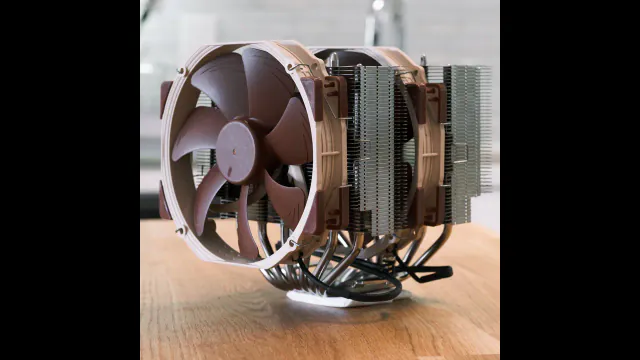
The processor a local model falls back on is not the clock a frame chart picks
A buyer guide to desktop processors for llama.cpp, Ollama, and LM Studio when layers fall off the graphics card. The shop cards are a Ryzen 9 9950X, a Ryzen 9 9900X, a Ryzen 7 9700X, a Core Ultra 9 285K, and a Core Ultra 7 265K. Two memory channels are the ceiling. Artificial Examiner has not bench-tested these chips. The links are affiliate.
TORONTO — October 6, 2026
A frame chart ranks the clock that finishes the frame. A local model that does not fit on the card ranks the processor the leftover layers fall back on. A higher boost does not add a memory channel. It does not add a PCIe lane. It does not turn an AVX2 line on a spec page into AVX-512.
Yesterday afternoon’s guide was the power that has to stay up while the job runs. That UPS is a watt ceiling, not a chip. Yesterday morning’s guide was the card. That 16 GB card is the pool the weights want first. Sunday afternoon’s guide was the box without a slot to put a card in. That mini PC already has a processor soldered to a laptop-class board. The file still sits on a drive until a loader maps it, which was Saturday’s disk guide. The working set on a machine with no discrete card is still system RAM, which was Saturday’s memory guide. The pane you watch the log on is still Sunday morning’s monitor. None of those six is this socket.
The chips under this story are affiliate links. If you buy through them, Artificial Examiner may earn a commission. Artificial Examiner has not bench-tested these processors. There is no speed figure in this piece, because this desk did not time a model on any of them. There is no price in this piece.
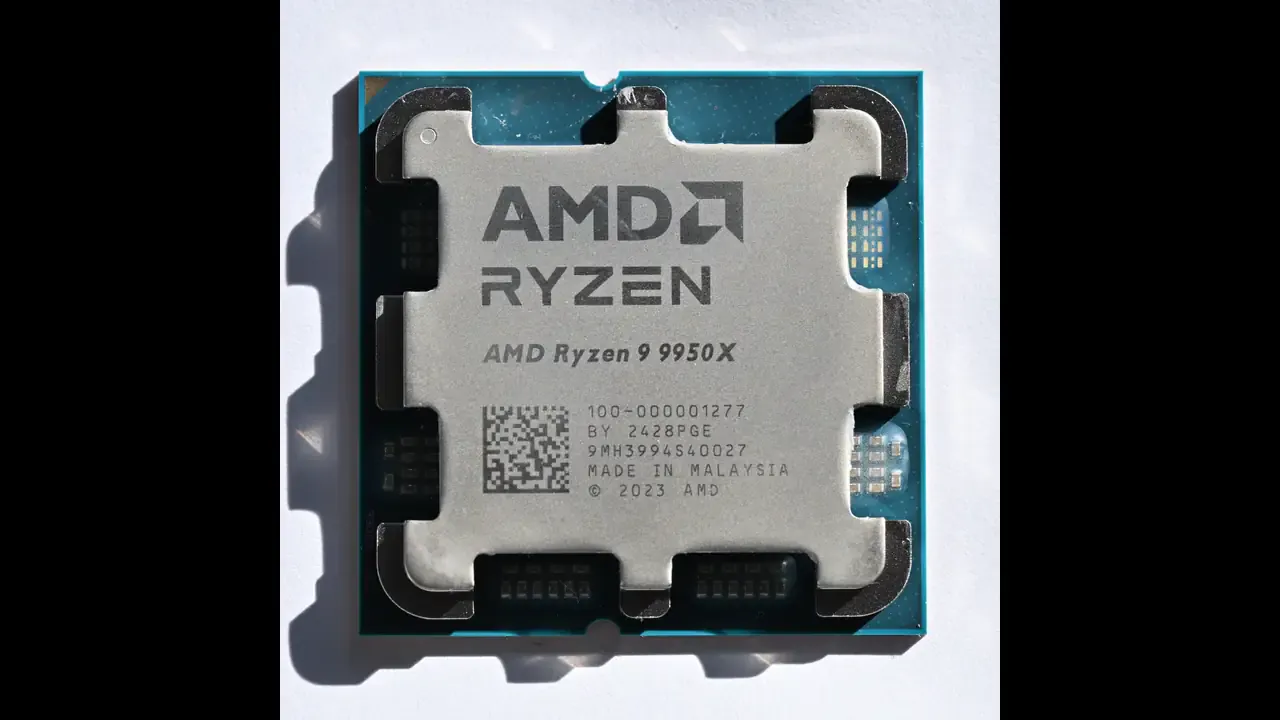
The photograph is an AMD Ryzen 9 9950X, taken by 4300streetcar on 27 November 2024. It is a Commons photograph of that chip. It is not the image on the Amazon listing. The listing image is a different file, and the 9900X listing uses that same Amazon file.
The chart wants a clock. The leftover layers want a memory bus, a lane for the card, and an instruction set the binary was actually built for.
What the chart is measuring
Treat the next sections as planning arithmetic, not as a timed test from this desk.
llama.cpp can leave layers on the CPU when they do not fit in the card. That split was yesterday morning’s point: a card that holds part of the file does not become a larger card. Ollama and LM Studio can be pointed at a graphics device when the machine exposes one. What does not fit stays in system RAM, on the processor. The next token from a layer that lives in that RAM has to cross the memory bus. Prompt processing is the other job. It is the pass over the prompt before the reply starts, and it is the part a core count and a wide instruction set can move. Generation of those leftover layers is the part the bus moves.
llama.cpp’s CPU build notes say that building with BLAS may improve prompt processing at batch sizes above 32, and that using BLAS does not affect generation performance. The same notes say a oneAPI build can expose AVX-VNNI on Intel processors that do not support AVX-512. That is a software sentence about two different jobs. It is not a tokens-per-second figure from this desk.
Two channels, and what four modules do to the official speed
Every spec page below prints two memory channels.
AMD’s page for the Ryzen 9 9950X lists DDR5, UDIMM, two channels, and a maximum of 256 GB. The maximum-speed lines are 2x1R and 2x2R at DDR5-5600, and 4x1R and 4x2R at DDR5-3600. ECC is yes, and the same cell says it requires motherboard support. The 9900X page and the 9700X page print the same memory block. Sixteen cores do not get a third channel. Eight cores do not get a narrower one. Four modules are an official speed cut on those pages, from DDR5-5600 down to DDR5-3600. That cut is the page. It is not a feeling about crowded slots.
Intel’s page for the Core Ultra 9 285K lists a maximum of 256 GB, memory types up to DDR5 6400 MT/s, two channels, and ECC supported. The 265K page prints the same memory block. Neither Intel page prints a separate speed for four modules. This desk is not inventing one. A higher official MT/s on two channels is still two channels. It is not the eight-channel or four-channel part this guide is not selling.
Saturday’s modules were SODIMMs, for laptops and for the mini PCs. AMD’s subtype cell on these three pages says UDIMM. A laptop module does not seat in that slot. The capacity arithmetic from Saturday still applies to whatever you do seat: the working set is system RAM, and the card’s video memory is a different pool.
The lanes the card actually gets
The card from yesterday needs a slot that the processor’s lanes can feed.
AMD prints PCI Express version 5.0 and native lanes as 28 total, 24 usable, on all three of those pages. The same connectivity block lists extra usable lanes from the motherboard, and the count depends on the chipset: X870E is 8x Gen4, X870 is 4x Gen4, X670E and X670 are 12x Gen4, B650E and B650 are 8x Gen4. Those chipset lanes are not the 24. A 16-lane card uses part of the 24. The AMD pages do not print a 2x8 split. This desk did not open a motherboard manual, and this desk is not turning 24 into a second graphics pool.
Intel prints a maximum of 24 PCI Express lanes, revision 5.0 and 4.0, on both pages. The configurations line reads: up to 1x16+2x4, 2x8+2x4, 1x8+4x4. A single card at x16 plus two x4 links is the first of those. Two cards at x8 is the second. Both are ways of spending the same 24. Direct Media Interface is listed separately, revision 4, maximum 8 lanes. That is the link to the chipset. It is not another x16 slot. A PCIe 5.0 mark on a title is still the generation of a link. Yesterday’s card guide already said it is not a second memory pool.
The socket is the other lock. AMD prints AM5, and a chipset list that runs from A620 through X870E. Intel’s package section prints FCLGA1851. Amazon’s socket cell on both Intel listings prints LGA 1851. This desk is reading those as one socket under two labels, not as two products. A board bought for one of them does not take the other.
AVX-512, the NPU row, and the graphics that are not the card
AMD’s supported-extensions line on all three pages includes AVX512, alongside AVX and AVX2. Intel’s instruction-set-extensions line on both pages is SSE4.1, SSE4.2, and AVX2. AVX-512 is not on that Intel line. Intel also prints Hyper-Threading as No, so the 285K’s 24 cores are 24 threads and the 265K’s 20 cores are 20 threads. AMD prints SMT as yes, so the thread count is double the cores. A thread is not a memory channel, and a core is not one either.
A binary still has to have been built for the extensions the chip has. The llama.cpp note above is the project’s own wording for Intel processors that do not support AVX-512. An AMD page that lists AVX512 does not rewrite a binary that was built without it. This desk did not compile either one.
Intel’s NPU block names Intel AI Boost, peak 13 TOPS at Int8, on both the 285K and the 265K. The frameworks cell lists OpenVINO, WindowsML, DirectML, ONNX RT, and WebNN. llama.cpp, Ollama, and LM Studio are not in that cell. Overall peak TOPS on the same pages is 36 for the 285K and 33 for the 265K. GPU peak TOPS is 8, and the graphics block lists 4 Xe-cores. Those are the pages’ figures. This desk did not run the test that produced them. They are not gigabytes.
AMD’s graphics block, on all three pages, is Radeon Graphics, 2 cores, 2200 MHz. The pages do not list an NPU. Two integrated cores are not yesterday’s 16 GB card, and they are not a pool you measure in gigabytes of video memory. The NPU in Sunday’s mini PCs belongs to a different chip, in a machine that has no slot to fill later. This guide does not re-buy that box.
Intel’s CPU block also says Deep Learning Boost on the CPU is yes, and names the same class of frameworks. The extensions line still stops at AVX2. This desk is not reading Deep Learning Boost as a silent AVX-512.
What the five chips are
Other desktop processors exist. Some print more than two memory channels. Some are sold as tray parts with no retail box. These five are only the listings we can attach to a real Amazon Associates tag, threadandfade-20. We are not ranking them against each other or against any chip we cannot link.
One chip is the AMD Ryzen™ 9 9950X 16-Core, 32-Thread Unlocked Desktop Processor. The short name is the Ryzen 9 9950X. The Amazon title is that sentence. The about-this-item lines say 16 cores and 32 threads, Zen 5, a 5.7 GHz max boost, 80 MB cache, DDR5-5600, socket AM5, PCIe 5.0 on select motherboards, and cooler not included, liquid cooler recommended. AMD’s page agrees on 16 cores, 32 threads, a max boost up to 5.7 GHz, a 4.3 GHz base, and a 170W default TDP. L2 is 16 MB and L3 is 64 MB. The Amazon table prints a secondary cache of 16 MB, a cache installed size of 80, and a wattage of 170 watts. Sixteen plus sixty-four is eighty. We are not treating the Amazon column labels as a second data sheet. The model number and the manufacturer part number on Amazon both say AMD Ryzen™ 9 9950X. AMD’s boxed product ID is 100-100001277WOF, and the tray ID is 100-000001277. Amazon does not print the WOF code in the part-number cell. We are carding the title. The landing image on this page, when this desk opened it on 6 October 2026, was the same Amazon file as the 9900X page. The photograph at the top of this story is not that file. The page showed In Stock, and a line that ships from and is sold by Amazon.com. A resale offer was also on the page. Those lines are inventory. They will move. They are not a spec.
The second chip is the AMD Ryzen™ 9 9900X 12-Core, 24-Thread Unlocked Desktop Processor. The short name is the Ryzen 9 9900X. The about lines say 12 cores and 24 threads, Zen 5, a 5.6 GHz max boost, 76 MB cache, DDR5-5600, AM5, PCIe 5.0 on select motherboards, and cooler not included. AMD’s page agrees: 12 cores, 24 threads, boost up to 5.6 GHz, base 4.4 GHz, default TDP 120W, L2 of 12 MB, L3 of 64 MB, liquid cooler recommended, thermal solution not included. The Amazon table prints secondary cache 12 MB, cache installed size 76, and wattage 120 watts. Twelve plus sixty-four is seventy-six. Same reading as the 9950X, and the same landing image. Do not tell these two apart by the photo. The model number on Amazon is AMD Ryzen™ 9 9900X. AMD’s boxed product ID is 100-100000662WOF. The page showed In Stock and a line that ships from and is sold by Amazon.com. Other sellers were on the page as well. Inventory, not a spec. The channels, the AVX512 line, and the 24 usable lanes match the 9950X page. The core count does not.
The third chip is the AMD Ryzen™ 7 9700X 8-Core, 16-Thread Unlocked Desktop Processor. The short name is the Ryzen 7 9700X. The about lines say 8 cores and 16 threads, Zen 5, a 5.5 GHz max boost, 40 MB cache, DDR5-5600, AM5, PCIe 5.0 on select motherboards, and cooler not included. AMD’s page agrees on the cores, the threads, the 5.5 GHz boost, and a 3.8 GHz base. L2 is 8 MB and L3 is 32 MB. Package die count is 2, where the 9950X and 9900X pages say 3. That is why the L3 cache on this page is 32 MB and not 64 MB. Default TDP on AMD’s page is 65W, and the recommended cooler is a premium air cooler. The thermal solution is not included. Amazon’s table prints wattage 105 watts, secondary cache 8 MB, and cache installed size 40 MB. Eight plus thirty-two is forty. The wattage cells do not add. We are not averaging 65 and 105, and we are not picking the retail table over the spec page. The model number on Amazon says 9700X. The manufacturer part number says AMD Ryzen™ 7 9700X. AMD’s boxed product ID is 100-100001404WOF, and the tray ID is 100-000001404. A seller block on the Amazon page advertised a new tray package, from DEVECHO INC. The title does not say tray. We are carding the title. If the part that arrives is a tray, that is the seller’s line, not a different core count. When this desk opened the listing on 6 October 2026, the page also showed In Stock and a line that ships from and is sold by Amazon.com. Inventory, not a spec.
The fourth chip is the Intel® Core™ Ultra 9 Processor 285K 24 cores (8 P-cores + 16 E-cores) up to 5.7 GHz. The short name is the Core Ultra 9 285K. The about lines say 24 cores, 8 performance cores plus 16 efficient cores, 24 threads, integrated Intel graphics, up to 5.7 GHz unlocked, 40MB cache, Intel 800 series chipsets, PCIe 5.0 and 4.0, and no thermal solution included. The product description says DDR5 support and 125W processor base power. Intel’s page agrees on 8 performance cores, 16 efficient cores, 24 threads, and a 5.7 GHz max turbo, which is also the thermal-velocity-boost figure. Performance-core max turbo is 5.5 GHz. The cache cell is 36 MB of Smart Cache, and total L2 is 40 MB. Processor base power is 125 W. Maximum turbo power is 250 W. Amazon’s table prints processor series Core i9, secondary cache 36 MB, cache installed size 40 MB, wattage 125 watts, and 24 cores and 24 threads. The model number says Intel Core Ultra 9 285K. The manufacturer part number says BX80768285K. A series cell that says Core i9 is not the name in the title. We are carding the title and BX80768285K. We are not carding Core i9. The bullet’s 40MB cache matches Intel’s L2 figure, not the 36 MB Smart Cache. The Amazon wattage cell matches the base power. It does not print the 250 W maximum turbo power. Yesterday’s UPS guide was a watt ceiling. A planning number that uses only the Amazon cell is the base, not the turbo. This desk did not put a meter on either figure. When this desk opened the listing on 6 October 2026, the page showed a line that ships from and is sold by Amazon.com, another seller named Wazno Electronics, and a used offer from Amazon Resale. Those lines are inventory. They are not a spec.
The fifth chip is the Intel Core Ultra 7 Desktop Processor 265K - 20 cores (8 P-cores + 12 E-cores) up to 5.5 GHz. The short name is the Core Ultra 7 265K. The about lines say 20 cores, 8 performance cores plus 12 efficient cores, 20 threads, up to 5.5 GHz unlocked, 36MB cache, Intel 800 series chipsets, PCIe 5.0 and 4.0, and no thermal solution included. The description says DDR5 support and 125W processor base power. Intel’s page agrees on 20 cores, 20 threads, and a 5.5 GHz max turbo. Performance-core max turbo is 5.4 GHz. Smart Cache is 30 MB. Total L2 is 36 MB. Base power is 125 W. Maximum turbo power is 250 W. The NPU, the two channels, the 24 lanes, and the AVX2 line match the 285K page. Overall peak TOPS on this page is 33, not 36. Amazon’s table prints series Intel Core Ultra 7, secondary cache 30 MB, cache installed size 36 MB, wattage 125 watts, and part number BX80768265K. The bullet’s 36MB cache matches the L2 figure, not the 30 MB Smart Cache. Same pattern as the 285K bullet, with the numbers swapped to this chip. The model number says Intel Core Ultra 7 265K. We are carding that name and BX80768265K. The offers this desk could read were third-party. One block shipped from and was sold by iTech365, with a quantity line that said only 2 left. Another seller on the page was planet technology. A resale offer was also present. Those lines are inventory. They will move. They are not a spec.
None of the five Amazon about-lines puts a cooler in the box. AMD’s pages say the thermal solution is not included, and they recommend a liquid cooler for the 9950X and the 9900X and a premium air cooler for the 9700X. Intel’s package section names a thermal solution specification, PCG 2020A, which is not a cooler photographed in a tray. This is not a cooler guide. A chip that arrives without a cooler does not boot because the spec page listed a TDP.
Which listing to read for which limit
Choose the Ryzen 9 9950X when the count you want is 16 cores and 32 threads, the AMD page’s AVX512 line is the extension list you mean to use, and you have already planned a cooler around the 170W default TDP and the liquid-cooler recommendation. The channels are still two. The usable lanes are still 24. The part to match is the title, AMD Ryzen™ 9 9950X. Leave the shared Amazon photograph out of the choice. It is also the 9900X’s photograph.
Choose the Ryzen 9 9900X when 12 cores and 24 threads is the count, and the AMD page’s 120W default TDP is the power cell you are willing to plan around. The memory block and the lane count match the 9950X. The landing image matches it too. The core count does not.
Choose the Ryzen 7 9700X when 8 cores is the count you actually intend to point at a prompt, and you have read both wattage cells before you buy a cooler. AMD says 65W and a premium air cooler. Amazon says 105 watts. L3 on the AMD page is 32 MB, on a package die count of 2. If the shipment is the tray the DEVECHO line advertised, stop and look. The title you clicked did not say tray.
Choose the Core Ultra 9 285K when you want 24 cores that are also 24 threads, the NPU row is something you have a framework for, and you have already accepted that Intel’s extension line stops at AVX2. The part number is BX80768285K. The series cell that says Core i9 is the wrong name. The PCIe configurations include a 2x8 split the AMD pages do not print. The channels are still two. Budget the cooler and yesterday’s watt ceiling for the 250 W maximum turbo power if that is the figure you believe, and do not pretend the Amazon cell’s 125 watts is the whole of Intel’s page.
Choose the Core Ultra 7 265K when 20 cores and 20 threads is the count, and the rest of the Intel platform is what you wanted from the 285K: two DDR5 channels, 24 lanes, AVX2, and an NPU cell at 13 TOPS whose frameworks list does not name llama.cpp. The part number is BX80768265K. Read 30 MB of Smart Cache and 36 MB of L2 as two Intel figures. Read the bullet’s 36MB cache as the line that matches only one of them.
A clock we did not measure is the wrong reason to choose. A review on the page that liked a game is the wrong reason too. The chips are the listings. Artificial Examiner has not opened these boxes, has not seated them, has not loaded a GGUF on them, and has not pointed Ollama or LM Studio at them. The blurbs under the story say that in shorter form.
The buttons under the article go to those five Amazon listings with our Associates tag, threadandfade-20. They are advertisements. The commission, if a purchase happens, does not pick the channel count. The two channels the leftover layers have to cross do.
This story includes affiliate links. If you buy through them, Artificial Examiner may earn a commission. That does not change the reporting. See our affiliate disclosure.